
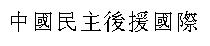
Proposed Direction and Timeline to the Chinese Government for the Implementation of Political Reform in the People’s Republic of China
Xu Wenli
(May 15 2006)
We recognize and applaud the efforts taken by the various Chinese political opposition factions in lobbying for political change or reform in the People’s Republic of China and in suggesting the various political propositions and proposals presented thus far.
Our suggestion of a “Proposal of Direction and Timeline for Political Reform in China” is but one of the many political initiatives that have been proposed and I warmly welcome any form of criticism, recommendations or additional input on this issue.
One of the most successful measures undertaken in today’s international political arena to achieve political progress is through the formulation of timelines and blueprints.
In the world of today, there is probably no issue more serious and more pressing than the topic of political reform and change in a China that houses 1.3 billion of the world’s population.
As long as political reform is not implemented in China, the Chinese people cannot retain the benefits nor relieve the suffering that has accompanied the recent economic reforms. Neither can China hope to progress towards a future of justice, equality, stability, and prosperity, nor can it dispel the doubts and reservations that nations around the world have regarding China’s future.
Moreover, an article published in the Xinhua Daily on behalf of the Communist Politburo on February 25, 1939 has stated, “They (Kuomintang) think that democracy in China is something that belongs not to the present but somewhere in the distant future. Their hope is for the Chinese people to first elevate their knowledge and educational level to one comparable to the capitalist and democratic nations of the West before they can begin to implement democracy. Actually, it is precisely under a democratic system that people can be more easily trained and educated.”
Additionally, an article from the Xinhua Daily on behalf of the Communist Politburo on February 1 1944 has stated, “In order to maintain our international status, we must begin by guaranteeing the fundamental democratic rights of the people. Fear represents cowardice, doubt represents selfishness, and opposition represents backwardness. We urge once again: Guarantee the fundamental democratic rights of the people.
On October 28, 1941, Liberation Daily published an article on behalf of the Communist Politburo, stating that “Right now, in order to establish a democratic political system, the key is to end a single-party government.”
On April 19, 1944, Xinhua Daily stated on behalf of the Communist Politburo that “Democracy and freedom of speech are inseparable.”
On February 2, 1944, Xinhua Daily once again stated on behalf of the Communist Politburo that “We must completely, fully, and effectively implement popular elections, so the people can realistically enjoy ‘popular’ and ‘equal’ right to election. With regards to the right to be elected, we must adhere to the words of Mr. Sun Yat-sen in that before every election, ‘we must guarantee that every person and organization from every locality has the right to vote and has the freedom to propose, publicize and discuss any policy propositions.’ This necessarily means that ‘we must guarantee that the people have the complete freedom of assembly, of speech, to publish, and to unionize’, otherwise, the so-called right to election is merely a right on paper.”
Therefore, at a point where the Chinese Communist Party has governed Mainland China for 57 years, at a point where economic reforms have been in practice for 28 years, at a point where the economy is growing but social conflict is also increasingly sharpening, immediately urging the Communist party to implement political change or reform is but a natural thing to do.
Thus, we propose that:
1. Beginning from 2007, Mainland China should implement five years of gradual political changes or reforms that will allow the completion of the initial objectives of political reform by 2011, which is the 100th anniversary of the founding of the Republic of China, the first republic in Asia.
2. The Chinese Communist Party should emulate the Nationalist Party (Kuomintang) and the Vietnamese Communist Party in holding multi-candidate elections for its General Secretary. Democratization should first begin from within the Chinese Communist Party itself.
3. Beginning from June 1, 2007, after all necessary preparation, the People’s Congress should authorize the gradual release of all prisoners that have been arrested for political, ideological, speech, religious, minority rights and other reasons. Additionally, the government should also allow all political dissidents that are exiled overseas to return to their home country.
4. Under the condition that the Chinese Communist government has implemented point number 2, which permits the release of all political prisoners and prisoners of conscience, as well as allowing all overseas exiles to return to their home country, all Chinese political opposition factions, whether in China or abroad, will cease all political activities during the 2008 Olympics in Beijing, as a gesture of reciprocity.
5. After more than a year of planning and preparations beginning from 2008, the Chinese Communist Party and all Chinese political opposition factions should collaborate in organizing and participating in the “Future of China Conference”, to be held in the fall of 2009 in Beijing. This conference should primarily focus on discussing the vital issues surrounding China’s political development and on charting China’s political direction. A “Constitutional Convention” will be subsequently convened in 2010 upon legitimate authorization by the “Future of China Conference”.
Local and overseas political opposition factions and the Chinese Communist Party will each begin to organize and establish a communication group, comprising approximately 20 members. Each group should encompass a sub-team responsible for researching the planning and implementation of political reforms prior to the conference in 2009. The sub-teams should also hold at least two open, honest and friendly discussions between the beginning of 2007 and the fall of 2008, allowing a full year before the 2009 “Future of China Conference”. Ideally, relevant authorities from the United Nations should be involved in the organization, mediation and supervision of these discussions, which will be conducted once in Mainland China and the other abroad, in order to make ample preparations for the topics, schedules and implementation of the conference itself. One of the starting points of discussion could be the return of exiled political dissidents.
The “Future of China Conference” should have no less than 100 representatives from the Chinese political opposition factions. These 100 representatives should be selected through negotiations among the different executive committees of the opposition groups.
6. Members of the Constitutional Convention should first make a public declaration to the Chinese people that they will never seek any form of “dominant authority” in the future.
7. At the same time, the Chinese Communist Party should hold open, peaceful and constructive dialogues with the Taiwanese government and its other political parties, the Tibetan government in exile headed by the Dalai Lama, Falun Gong members, as well as the victims of the June 4th Tiananmen Incident. Their key representatives should be included in the 2009 “Future of China Conference” in Beijing.
8. The legislative procedures of the “News Publication Law” should be completed no later than the beginning of 2009, henceforth allowing freedom of the press in Mainland China.
9. In 2009, one or two provinces, such as Fujian, Guangdong or Hainan, should be designated as Early Political Reform Provinces, allowing for the early implementation of the Freedom of the Press and Freedom of Association legislation in these areas. Direct elections at the county and city district levels should be held no later than 2010. Building upon the foundations of experience, direct elections should also be held at the provincial level in 2011. Direct elections for the Chief Executive of the Hong Kong Special Administrative Region should be held in 2008.
10. The implementation of political reform in Mainland China should at least achieve these targets as mentioned below:
(1) Any political organization, be it the Chinese Communist Party or any other political groups, must not build up their party apparatus or political organizations within the government’s administrative departments or upon the military might of the Chinese army. Under the stipulations of China’s “Political Organizations Law”, the Chinese Communist Party and other political groupings are entitled to equal access to political power and the right to fair competition. No one political party should enjoy privileged political status or power.
(2) It is only when a parliament arises out of popular, nation-wide elections by the people themselves can it be truly considered as vested with the nation’s highest authority. China’s premier must be selected either through direct or indirect elections by the Chinese people.
(3) A nationalized and neutral military force will be commanded by the democratically elected president of the country. With the exception of the commander-in-chief, no other official within the military is allowed to interfere with the political matters of the country; otherwise he will be most severely punished by military law.
(4) The country will continue to implement open market economic policies.
(5) The country will not pursue regional supremacy and world hegemony, therefore allowing China to become an influential and responsible member of the international community.
Monday, May 28, 2007


Wednesday, May 16, 2007
Burma's Democracy Movement May Boycott China's Geoncide Olympics
This interesting re-posted article (originally from Dictator Watch) is from a viewpoint aligned with Burma's pro-democracy movement. CSN and Chinese dissidents have stood in solidarity, where we have great sympathy with Burma's pro-democracy movement -- it suffers under a military dictatorship that is propped up by Communist China, the dictator-friendly regime.
FREE BURMA!
BOYCOTT CHINA’S GENOCIDE OLYMPICS!
BOYCOTT CHINA’S GENOCIDE OLYMPICS!
Roland Watson
May 2007
Often the question is asked: What can we who are outside Burma do to make a real difference in the struggle for freedom? Other than funding the armed resistance groups, which many people are unwilling to do, there are few choices.
Most of the tactics of modern activism, and which do have a positive effect in other important social movements, achieve nothing with the SPDC. Than Shwe ignores petitions, letters, and even demonstrations and lobbying.
For the democracy movement to have any impact at all, we have to hurt him. We have to hurt the SPDC and its supporters. Anything that we do that doesn’t accomplish this is a waste of time and money.
Recently, an event occurred that revealed an important weakness in the enemy, and therefore a crucial opportunity.
In late March, Mia Farrow, an actress and a goodwill ambassador for Unicef (http://www.miafarrow.org/), together with Ronan Farrow, who is a law student at Yale University, wrote an editorial in the Wall Street Journal titled, The ‘Genocide Olympics.’ They called for pressure against China, the host of the 2008 Olympics, and the Games’ corporate sponsors.
Their argument is that China is the leading supporter of Omar al-Bashir, the dictator of Sudan, who is committing genocide against the people of the Darfur region. China buys two-thirds of Sudan’s oil exports, and together with Russia supplies its military with the weapons that are being used in the genocide.
The week after the editorial was published, China sent a diplomatic envoy to Sudan. The week after that al-Bashir relented on a long-standing demand from the international community, and agreed to allow U.N. peacekeeping forces to enter Darfur and join the African Union forces already stationed there.
This event shows that China has great leverage over its clients, and is vulnerable on the issue of the Olympics. The dictators of the Communist Politburo are extremely sensitive and will respond to anything that might threaten the Games.
China should be criticized, and the Genocide Olympics boycotted, for Burma as much as for Sudan. As its veto (together with Russia) of the Security Council resolution against the SPDC demonstrates, it is the bulwark of the junta.
In Darfur, over 2.5 million people have been displaced. In Burma, it’s 2 million. In Darfur, reportedly 200,000 villagers and internally displaced persons have been killed. For Burma, while we do not have accurate comparable information, a huge number of people have been killed by Tatmadaw troops, or died from disease and malnutrition as a result of having their homes and lives destroyed.
Genocide, in any case, is not about numbers. It’s about intent, the intent to destroy all or part of a distinct ethnic, racial or religious group. When the Tatmadaw attacks ethnic villages, if the villagers didn’t have forests to hide in they would be slaughtered outright. It is still attempted genocide, even if they are able to escape mass murder by living rough in the mountains or taking refuge in Thailand.
Darfur has been publicly labeled genocide. Burma has not, but this is largely a matter of semantics. It also reflects the international community’s unwillingness to acknowledge that there is a second genocide underway in the world, as this would force it to become involved.
Some people may say that what is happening in Eastern Burma is not genocide. I question their motives. For damn sure it’s ethnic cleansing, and at a minimum a formal Security Council investigation needs to be opened, and U.N. peacekeeping force organized.
There will be many demonstrations at the end of this month and beyond, on behalf of Daw Aung San Suu Kyi and the Burma democracy movement. All of these demos should have placards, banners and chants in opposition to the Genocide Olympics. Everyone who is interviewed by the media should make this a leading talking point.
We should also boycott the corporate sponsors. These include:
Adidas, Coca-Cola, Atos Origin, General Electric, Johnson & Johnson, Eastman Kodak, Lenova Group, McDonald’s, Panasonic, Samsung, Swatch, Visa, and Voltzwagen.
The Farrow editorial further pilloried film director Steven Spielberg, who is assisting with the Games’ opening ceremony, comparing him to Leni Riefenstahl, who helped Adolf Hitler publicize the 1936 Berlin Olympics. Mr. Spielberg is Jewish, and has documented the Holocaust. It is hypocritical for him to assist China, a co-perpetrator of genocide in other countries, and which brutally subjugates its own people. (Amnesty International recently reported that China is using the Games as an excuse to increase its internal repression.)
Mr. Spielberg is therefore a legitimate demonstration target. In his case protest letters may have an impact. His address is DreamWorks SKG, 1000 Flower Street, Glendale, CA 91201. He would certainly also be a candidate for a biting slogan on a protest sign. [Editor's note. Spielberg was moved by the pressure, and he sent a letter to CCP President Hu Jintao. We should assume that he is against genocide and not a willing collaborator. Maybe the protest signs should target Hu Jintao, not Steven Spielberg.]
As time passes, we should expand this boycott to the athletes, and call upon them not to participate unless there is serious progress made both in Burma and Darfur. Moreover, everyone should boycott anything “Made in China.” It is well documented that the rural residents who migrate to China’s cities are subjected to factory and dormitory conditions that are equivalent to slavery. Everyone would now agree that it was morally reprehensible to benefit in any way from the black Africans who were brought to America to be slaves. Buying Chinese goods from Wal-Mart and other stores in the U.S., and around the world, legitimizes this new example of slavery. It also degrades the morality of anyone who buys such goods.
The Genocide Olympics begin August 8, 2008, which is also the twentieth anniversary of the massacre in the cities of Burma, through which the democracy movement was crushed. This is an insult to all the people of Burma. It also means that this opportunity, to pressure China, has a limited duration. We have just over a year to push on this point again and again, to get China to back down, including in the Security Council, and to leave the SPDC open and exposed.
The people inside Burma can participate as well, by boycotting Chinese merchants. I noted in my article, Lessons from the American Revolution, that American colonists in their protest of British rule launched non-importation movements – boycotts – of British goods.
The Olympics in China are properly going to be contentious and controversial. They should never have been awarded to Beijing. They were a gift from the last dictator of the International Olympic Committee, Juan Antonio Samaranch, to the leading political dictatorship on earth. Everyone has a responsibility to do something about this. We want the Genocide Olympics to completely and utterly fail. What Hitler did in 1936, using the Games to promote his own plans for supremacy, cannot be repeated by China.
There are many Burmese people, and international parties, who do not want Burma to be free. They preoccupy the movement by arguing ad nauseam about such things as sanctions and humanitarian aid programs, as a means to divert our attention from the types of actions that would lead to the defeat of Than Shwe. For everyone who sincerely wants to see the end of the SPDC, there is now something that we can do.
May 2007
Often the question is asked: What can we who are outside Burma do to make a real difference in the struggle for freedom? Other than funding the armed resistance groups, which many people are unwilling to do, there are few choices.
Most of the tactics of modern activism, and which do have a positive effect in other important social movements, achieve nothing with the SPDC. Than Shwe ignores petitions, letters, and even demonstrations and lobbying.
For the democracy movement to have any impact at all, we have to hurt him. We have to hurt the SPDC and its supporters. Anything that we do that doesn’t accomplish this is a waste of time and money.
Recently, an event occurred that revealed an important weakness in the enemy, and therefore a crucial opportunity.
In late March, Mia Farrow, an actress and a goodwill ambassador for Unicef (http://www.miafarrow.org/), together with Ronan Farrow, who is a law student at Yale University, wrote an editorial in the Wall Street Journal titled, The ‘Genocide Olympics.’ They called for pressure against China, the host of the 2008 Olympics, and the Games’ corporate sponsors.
Their argument is that China is the leading supporter of Omar al-Bashir, the dictator of Sudan, who is committing genocide against the people of the Darfur region. China buys two-thirds of Sudan’s oil exports, and together with Russia supplies its military with the weapons that are being used in the genocide.
The week after the editorial was published, China sent a diplomatic envoy to Sudan. The week after that al-Bashir relented on a long-standing demand from the international community, and agreed to allow U.N. peacekeeping forces to enter Darfur and join the African Union forces already stationed there.
This event shows that China has great leverage over its clients, and is vulnerable on the issue of the Olympics. The dictators of the Communist Politburo are extremely sensitive and will respond to anything that might threaten the Games.
China should be criticized, and the Genocide Olympics boycotted, for Burma as much as for Sudan. As its veto (together with Russia) of the Security Council resolution against the SPDC demonstrates, it is the bulwark of the junta.
In Darfur, over 2.5 million people have been displaced. In Burma, it’s 2 million. In Darfur, reportedly 200,000 villagers and internally displaced persons have been killed. For Burma, while we do not have accurate comparable information, a huge number of people have been killed by Tatmadaw troops, or died from disease and malnutrition as a result of having their homes and lives destroyed.
Genocide, in any case, is not about numbers. It’s about intent, the intent to destroy all or part of a distinct ethnic, racial or religious group. When the Tatmadaw attacks ethnic villages, if the villagers didn’t have forests to hide in they would be slaughtered outright. It is still attempted genocide, even if they are able to escape mass murder by living rough in the mountains or taking refuge in Thailand.
Darfur has been publicly labeled genocide. Burma has not, but this is largely a matter of semantics. It also reflects the international community’s unwillingness to acknowledge that there is a second genocide underway in the world, as this would force it to become involved.
Some people may say that what is happening in Eastern Burma is not genocide. I question their motives. For damn sure it’s ethnic cleansing, and at a minimum a formal Security Council investigation needs to be opened, and U.N. peacekeeping force organized.
There will be many demonstrations at the end of this month and beyond, on behalf of Daw Aung San Suu Kyi and the Burma democracy movement. All of these demos should have placards, banners and chants in opposition to the Genocide Olympics. Everyone who is interviewed by the media should make this a leading talking point.
We should also boycott the corporate sponsors. These include:
Adidas, Coca-Cola, Atos Origin, General Electric, Johnson & Johnson, Eastman Kodak, Lenova Group, McDonald’s, Panasonic, Samsung, Swatch, Visa, and Voltzwagen.
The Farrow editorial further pilloried film director Steven Spielberg, who is assisting with the Games’ opening ceremony, comparing him to Leni Riefenstahl, who helped Adolf Hitler publicize the 1936 Berlin Olympics. Mr. Spielberg is Jewish, and has documented the Holocaust. It is hypocritical for him to assist China, a co-perpetrator of genocide in other countries, and which brutally subjugates its own people. (Amnesty International recently reported that China is using the Games as an excuse to increase its internal repression.)
Mr. Spielberg is therefore a legitimate demonstration target. In his case protest letters may have an impact. His address is DreamWorks SKG, 1000 Flower Street, Glendale, CA 91201. He would certainly also be a candidate for a biting slogan on a protest sign. [Editor's note. Spielberg was moved by the pressure, and he sent a letter to CCP President Hu Jintao. We should assume that he is against genocide and not a willing collaborator. Maybe the protest signs should target Hu Jintao, not Steven Spielberg.]
As time passes, we should expand this boycott to the athletes, and call upon them not to participate unless there is serious progress made both in Burma and Darfur. Moreover, everyone should boycott anything “Made in China.” It is well documented that the rural residents who migrate to China’s cities are subjected to factory and dormitory conditions that are equivalent to slavery. Everyone would now agree that it was morally reprehensible to benefit in any way from the black Africans who were brought to America to be slaves. Buying Chinese goods from Wal-Mart and other stores in the U.S., and around the world, legitimizes this new example of slavery. It also degrades the morality of anyone who buys such goods.
The Genocide Olympics begin August 8, 2008, which is also the twentieth anniversary of the massacre in the cities of Burma, through which the democracy movement was crushed. This is an insult to all the people of Burma. It also means that this opportunity, to pressure China, has a limited duration. We have just over a year to push on this point again and again, to get China to back down, including in the Security Council, and to leave the SPDC open and exposed.
The people inside Burma can participate as well, by boycotting Chinese merchants. I noted in my article, Lessons from the American Revolution, that American colonists in their protest of British rule launched non-importation movements – boycotts – of British goods.
The Olympics in China are properly going to be contentious and controversial. They should never have been awarded to Beijing. They were a gift from the last dictator of the International Olympic Committee, Juan Antonio Samaranch, to the leading political dictatorship on earth. Everyone has a responsibility to do something about this. We want the Genocide Olympics to completely and utterly fail. What Hitler did in 1936, using the Games to promote his own plans for supremacy, cannot be repeated by China.
There are many Burmese people, and international parties, who do not want Burma to be free. They preoccupy the movement by arguing ad nauseam about such things as sanctions and humanitarian aid programs, as a means to divert our attention from the types of actions that would lead to the defeat of Than Shwe. For everyone who sincerely wants to see the end of the SPDC, there is now something that we can do.
Thursday, April 05, 2007
The story of an event & protest in Hollywood/L.A., 3/3/07
The Beijing Tourism Bureau sent out more than 500 people for a parade in Los Angeles to promote the 2008 Beijing Olympics, but encountered several hundred demonstrators protesting the event.
Hundreds of paraders versus hundreds of protestors
More than 500 performers came from Beijing. On the third day at noon they sang and danced on the Hollywood main road, welcoming people to Beijing to visit the Olympic Games and to experience Beijing. But the scene also had several hundred protesters holding various signs protesting the Chinese government's persecution of human rights. They demanded that there be freedom first, then hold the Olympics (Freedom Before Olympics).
The parade was held on the street in front of the Grauman's Chinese theater in Hollywood. A group of children dressed as prosperity dolls danced in their in-line skates and sang a welcome song composed for Los Angeles. Also, there were beautiful women dressed in Forbidden City clothing, flower drum team neatly lined up, stilts team teasing the audience, as well as different kinds of decorated floats and other performance groups. They also wished the audience a happy new year.
Mayor and council members welcome the visitors from afar
Los Angeles Mayor Antonio Villaraigosa, Councilmember Tom LaBonge, Councilmember Dennis Zine, Los Angeles Visitors and Tourism Bureau officials delivered speeches welcoming the visiting groups and congratulating the Los Angeles residents on the lunar new year.
Villaraigosa visited Beijing last year and has promoted Los Angeles tourism there. Villaraigosa painted the eyes of the lion and opened the parade prologue. Mayor Villaraigosa said, "Los Angeles is [the] first American city where China established its tourism office. Beijing may choose any city to conduct the lunar calendar new year parade, but has chosen Los Angeles; I feel deeply honored."
The Beijing government's Assistant Deputy Secretary-General Wang Yunfeng said, "The Los Angeles city has twice successfully held Olympic Games, Beijing hopes to benefit from Los Angeles' experience, produce a high standard 2008 Olympic Games."
A face off with demonstrators
The parade attracted many tourists but also brought in a large number of demonstrators. They occupied the sidewalk opposite the grand stand. Some hoisted the Tibetan flag and shouted loudly "Give Tibet Freedom", some holding photos of sentenced reporter Ching Cheong, Shi Tao and blind attorney Chen Guangcheng demanding their immediate release. There were also several hundred Falun Gong supporters protesting the persecution of human rights, all crammed full on two sides of the sidewalks.
The organizer brought in four large-scale tourist buses, and dispatched their parade team members to stand along the roadside in an attempt to block the demonstrators. Several high decibel loudspeakers also loudly broadcast music. The demonstrators could only move their positions, lifting up high the protest signs, waiting for the music to stop and then call out their various slogans.
Falun Gong member Zhang Peixing said that two tall cloth banners were snatched by the people from Beijing. They have reported the incident to the police.
Complaints about Los Angeles' government
The American Visual Artists Guild representative Ann Lau said that they are protesting Los Angeles City Mayor using taxpayers' money to help China promote the Beijing Olympics. Ann Lau said that closing the streets, having police for security, promotion by the Los Angeles Visitors Bureau, are all using the resources of the taxpayers. She has already asked the Mayor's office for a response but has yet to receive a reply.
Ann Lau said that the Beijing Olympic Games is the same as the 1936 Berlin Olympic Games, in providing propaganda for that country. China continues in its persecution of human rights, completely violating the basic Olympic spirit of respecting human dignity.
Los Angeles Councilmember Dennis Zine indicated that demonstrations in the US are very common; so long as it is lawful, all have the right to express their opinion. But Zine said that, "China is on the rise. [Los Angeles] maintaining firm economic, trade, tourist relations with China is very important. The mayor and I are very supportive."
Note: This report originally appeared at Voice of America. It was then translated into English and appeared at the web site of ITSN (International Tibet Support Network)'s 2008-Free Tibet campaign, www.games-of-beijing.org. The China Support Network further edited it to upgrade the English before placing it here.
Hundreds of paraders versus hundreds of protestors
More than 500 performers came from Beijing. On the third day at noon they sang and danced on the Hollywood main road, welcoming people to Beijing to visit the Olympic Games and to experience Beijing. But the scene also had several hundred protesters holding various signs protesting the Chinese government's persecution of human rights. They demanded that there be freedom first, then hold the Olympics (Freedom Before Olympics).
The parade was held on the street in front of the Grauman's Chinese theater in Hollywood. A group of children dressed as prosperity dolls danced in their in-line skates and sang a welcome song composed for Los Angeles. Also, there were beautiful women dressed in Forbidden City clothing, flower drum team neatly lined up, stilts team teasing the audience, as well as different kinds of decorated floats and other performance groups. They also wished the audience a happy new year.
Mayor and council members welcome the visitors from afar
Los Angeles Mayor Antonio Villaraigosa, Councilmember Tom LaBonge, Councilmember Dennis Zine, Los Angeles Visitors and Tourism Bureau officials delivered speeches welcoming the visiting groups and congratulating the Los Angeles residents on the lunar new year.
Villaraigosa visited Beijing last year and has promoted Los Angeles tourism there. Villaraigosa painted the eyes of the lion and opened the parade prologue. Mayor Villaraigosa said, "Los Angeles is [the] first American city where China established its tourism office. Beijing may choose any city to conduct the lunar calendar new year parade, but has chosen Los Angeles; I feel deeply honored."
The Beijing government's Assistant Deputy Secretary-General Wang Yunfeng said, "The Los Angeles city has twice successfully held Olympic Games, Beijing hopes to benefit from Los Angeles' experience, produce a high standard 2008 Olympic Games."
A face off with demonstrators
The parade attracted many tourists but also brought in a large number of demonstrators. They occupied the sidewalk opposite the grand stand. Some hoisted the Tibetan flag and shouted loudly "Give Tibet Freedom", some holding photos of sentenced reporter Ching Cheong, Shi Tao and blind attorney Chen Guangcheng demanding their immediate release. There were also several hundred Falun Gong supporters protesting the persecution of human rights, all crammed full on two sides of the sidewalks.
The organizer brought in four large-scale tourist buses, and dispatched their parade team members to stand along the roadside in an attempt to block the demonstrators. Several high decibel loudspeakers also loudly broadcast music. The demonstrators could only move their positions, lifting up high the protest signs, waiting for the music to stop and then call out their various slogans.
Falun Gong member Zhang Peixing said that two tall cloth banners were snatched by the people from Beijing. They have reported the incident to the police.
Complaints about Los Angeles' government
The American Visual Artists Guild representative Ann Lau said that they are protesting Los Angeles City Mayor using taxpayers' money to help China promote the Beijing Olympics. Ann Lau said that closing the streets, having police for security, promotion by the Los Angeles Visitors Bureau, are all using the resources of the taxpayers. She has already asked the Mayor's office for a response but has yet to receive a reply.
Ann Lau said that the Beijing Olympic Games is the same as the 1936 Berlin Olympic Games, in providing propaganda for that country. China continues in its persecution of human rights, completely violating the basic Olympic spirit of respecting human dignity.
Los Angeles Councilmember Dennis Zine indicated that demonstrations in the US are very common; so long as it is lawful, all have the right to express their opinion. But Zine said that, "China is on the rise. [Los Angeles] maintaining firm economic, trade, tourist relations with China is very important. The mayor and I are very supportive."
Note: This report originally appeared at Voice of America. It was then translated into English and appeared at the web site of ITSN (International Tibet Support Network)'s 2008-Free Tibet campaign, www.games-of-beijing.org. The China Support Network further edited it to upgrade the English before placing it here.
Saturday, March 17, 2007
CCP Defector Jia Jia Regains Freedom
According to NTDTV,
"A former Chinese official who defected from the Chinese communist party and sought refuge in Indonesia, has now been released by Indonesian officials. On March 9, Indonesian authorities detained Jia Jia and said they planned to deport him back to China. If sent back to China, Jia Jia would have faced grave danger. Jia Jia expressed his gratitude for those who helped him to regain freedom."
From the CSN, I sent one letter to the nearest U.S. consulate. We were about to make that a 'pressure' campaign, with more and more letters, but the good news about Jia Jia's release came quickly, before we were about to re-adjust the web site.
This is good news as far as it goes; but to our knowledge, Jia Jia still does not have a "free world" nation offering him refuge, asylum, or resettlement. The CSN continues to stand by D.J. McGuire's open letter to U.S. President George W. Bush, calling for the U.S. to grant political asylum to Jia Jia. He still needs that.
"A former Chinese official who defected from the Chinese communist party and sought refuge in Indonesia, has now been released by Indonesian officials. On March 9, Indonesian authorities detained Jia Jia and said they planned to deport him back to China. If sent back to China, Jia Jia would have faced grave danger. Jia Jia expressed his gratitude for those who helped him to regain freedom."
From the CSN, I sent one letter to the nearest U.S. consulate. We were about to make that a 'pressure' campaign, with more and more letters, but the good news about Jia Jia's release came quickly, before we were about to re-adjust the web site.
This is good news as far as it goes; but to our knowledge, Jia Jia still does not have a "free world" nation offering him refuge, asylum, or resettlement. The CSN continues to stand by D.J. McGuire's open letter to U.S. President George W. Bush, calling for the U.S. to grant political asylum to Jia Jia. He still needs that.
Friday, March 16, 2007
Official US State Department Memorandum on Legal Status of Taiwan
Memorandum
July 13, 1971
To: KA/ROC – Mr. Charles T. Sylvester
From: L/EA – Robert I. Starr
Subject: Legal Status of Taiwan
You have asked for a comprehensive memorandum analyzing the question of the legal status of Taiwan in terms suitable for Congressional presentation. Attached is a paper that should serve this purpose. It is drawn mainly from the February 3, 1961 Czyzak memorandum, and contains no sensitive information or reference to classified documents.
Concurrence: L – Mr. Salans
L:L/EA:RIStarr:cdj:7/13/71 ex 28900
Legal Status of Taiwan
Prior to the Korean Hostilities
From the middle of the 17th century to 1895, Formosa (Taiwan) and the Pescadores (Penghu) were part of the Chinese Empire. China then ceded these islands to Japan in 1895 in the Sino-Japanese Treaty of Shimonoseki1
In the Cairo Declaration of 1943, the United States, Great Britain, and China stated it to be their purpose that “all the territories that Japan has stolen from the Chinese, such as…Formosa and the Pescadores, shall be restored to the Republic of China”.2 These same three governments on July 26, 1945 issued the Potsdam Proclamation declaring that “the terms of the Cairo Declaration shall be carried out and Japanese sovereignty shall be limited to the islands of Honshu, Hokkaido, Kyushu, Shikoku, and such minor islands as we determine”.3 On August 8, 1945 the Soviet Union adhered to the Potsdam Proclamation. By an Imperial Rescript of September 2, 1945, the Japanese Emperor accepted the terms of the Potsdam Declaration, and in the Instrument of Surrender signed on the same date, the Japanese Government “and their successors” undertook to carry out the provisions of the Declaration.4
Pursuant to Japanese Imperial General Headquarters General Order No. 1, issued at the direction of the Supreme Commander for the Allied Powers (SCAP), Japanese commanders in Formosa surrendered to Generalissimo Chiang Kai-shek “acting on behalf of the United States, the Republic of China, the United Kingdom and the British Empire, and the Union of Soviet Socialist Republics.” Continuously since that time, the Government of the Republic of China has occupied and exercised authority over Formosa and the Pescadores.
The view of the U.S. in the intermediate post-war period was typified by a statement on April 11, 1947 of then Acting Secretary of State Acheson, in a letter to Senator Ball, that the transfer of sovereignty over Formosa to China “has not yet been formalized.”
After a prolonged period of civil strife the Chinese Communists succeeded in driving the Government of the Republic of China off the Chinese mainland. On October 1, 1949 the Chinese Communists proclaimed the establishment of the People’s Republic of China. The seat of the Government of the Republic of China was transferred to Formosa, and in early December 1949, Taipei became its provisional capital.
Shortly thereafter, President Truman, in a statement of January 5, 1950, referred to a U.N. General Assembly Resolution of December 8, 1949, (Res. 291(IV)) which called on all states to refrain from “(a) seeking to acquire spheres of influence or to create foreign controlled regimes within the territory of China; (b) seeking to obtain special rights or privileges within the territory of China.” He said:
“A specific application of the foregoing principles is seen in the present situation with respect to Formosa…
“The United States has no predatory designs on Formosa or on any other Chinese territory, The United States has no desire to obtain special rights or privileges or to establish military bases on Formosa at this time… the United States Government will no pursue a course which will lead to involvement in the civil conflict in China.”5
The Korean Conflict
The outbreak of hostilities in Korea on June 25, 1950 brought to the fore the question of the status of Formosa and the Pescadores. President Truman ordered the U.S. Seventh Fleet to prevent any attack on Formosa, and as a corollary called upon the Chinese Government on Formosa to cease all operations against the mainland. In addition, he stated that “the determination of the future status of Formosa must await the restoration of security in the Pacific, a peace settlement with Japan, or consideration by the United Nations.”6
On August 24, 1950 the United States explained its position to the United Nations Security Council in the following terms:
“The action of the United States was expressly to be without prejudice to the future political settlement of the status of the island. The actual status of the island is that it is territory taken from Japan by the victory of the allied forces in the Pacific. Like other such territories, its legal status cannot be fixed until there is international action to determine its future. The Chinese Government was asked by the allies to take the surrender of the Japanese forces on the Island. That is the reason the Chinese are there now.”7
By a letter dated September 20, 1950,8 the United States requested that the question of Formosa be placed on the agenda of the fifth session of the U.N. General Assembly. In an explanatory note of September 21, the United States, citing the Cairo and Potsdam declarations and the Japanese surrender, stated nevertheless:
“Formal transfer of Formosa to China was to await the conclusion of peace with Japan or some other appropriate formal act.”
That note also stated:
The Government of the United States has made it abundantly clear that the measures it has taken with respect to Formosa were without prejudice to the long-term political status of Formosa, and the United States has no territorial ambitions and seeks no special position of privilege with respect to Formosa. The United States believes further that the future of Formosa and of the nearly eight million people inhabited there should be settled by peaceful means in accordance with the Charter of the United Nations.”9
Japanese Peace Treaty
From September 4 to 8, 1951 a conference for the conclusion and signature of a Treaty of Peace was held at San Francisco. China was not represented at the Conference because of the disagreement among the participants as to who actually represented the government of that country. Reflecting this disagreement is article 2 of the Peace Treaty, which reads in its pertinent part:
“(b) Japan renounces all right, title, and claim to Formosa and the Pescadores.”10
John Foster Dulles, U.S. delegate at the Conference, commented on this provision in article 2:
“Some Allied Powers suggested that article 2 should not merely delimit Japanese sovereignty according to Potsdam, but specify precisely the ultimate disposition of each of the ex-Japanese territories. This, admittedly, would have been neater. But it would have raised questions as to which there are now no agreed answers. We had either to give Japan peace on the Potsdam Surrender Terms or deny peace to Japan while the allies quarrel about what shall be done with what Japan is prepared, and required, to give up. Clearly, the wise course was to proceed now, so far as Japan is concerned, leaving the future to resolve doubts by invoking international solvents other than this treaty.”11
The delegate of the United Kingdom remarked:
“The treaty also provides for Japan to renounce its sovereignty over Formosa and the Pescadores Islands. The treaty itself does not determine the future of these islands.”12
The USSR refused to sign the Treaty. It objected, among other things, to the provision regarding Formosa and the Pescadores:
“…this draft grossly violates the indisputable rights of China to the return of integral parts of Chinese territory: Taiwan, the Pescadores, the Paracel and other islands…. The draft contains only a reference to the renunciation by Japan of its rights to these territories but intentionally omits any mention of the further fate of these territories.”13
It is clear from these and other statements made at San Francisco, that although the Treaty provision constituted an appropriate act of renunciation by Japan, the future status of Formosa and the Pescadores was not considered to have finally been determined by the Peace Treaty.
The Senate Committee on Foreign Relations also took this view. In its Report on the Treaty dated February 14, 1952, the Committee stated:
“It is important to remember that article 2 is a renunciatory article and makes no provision for the power or powers which are to succeed Japan in the possession of and sovereignty over the ceded territory.
“During the negotiation of the Treaty some of the Allied Powers expressed the view that article 2 of the treaty should not only relieve Japan of its sovereignty over the territories in question but should indicate specifically what disposition was to be made of each of them. The committee believes, however, that this would have complicated and prolonged the conclusion of the peace. Under the circumstances it seems far better to have the treaty enter into force now, leaving to the future the final disposition of such areas as South Sakhalin and the Kuriles.”14
Although China was not a party to the San Francisco Treaty, a separate Treaty of Peace between the Republic of China and Japan was signed in Taipei on April 28, 1952.15 Article II of that treaty provided:
“It is recognized that under Article 2 of the Treaty of Peace with Japan signed at the city of San Francisco in the united States of America on September 8, 1951…, Japan has renounced all right, title and claim to Taiwan (Formosa) and Penghu (the Pescadores)….”
Explaining this provision to the Legislative Yuan, Foreign Minister Yeh of the Republic of China stated that under the San Francisco Peace Treaty “no provision was made for the return [of these islands] to China.” He continued:
“Inasmuch as these territories were originally owned by us and as they are now under our control and, furthermore, Japan has renounced in the Sino-Japanese peace treaty these territories under the San Francisco Treaty of Peace, they are, therefore, in fact restored to us.”16
At another point, Foreign Minister Yeh stated that “no provision has been made either in the San Francisco Treaty of Peace as to the future of Taiwan and Penghu.”17 During the interpellations of the Sino-Japanese Peace Treaty in the Legislative Yuan, the Foreign Minister was asked, “What is the status of Formosa and the Pescadores?” He replied:
“Formosa and the Pescadores were formerly Chinese territories. As Japan has renounced her claim to Formosa and the Pescadores, only China has the right to take them over. In fact, we are controlling them now, and undoubtedly they constitute a part of our territories. However, the delicate international situation makes it that they do not belong to us. Under present circumstances, Japan has no right to transfer Formosa an the Pescadores to us; nor can we accept such a transfer from Japan even if she so wishes…In the Sino-Japanese peace treaty, we have made provisions to signify that residents including juristic persons of Formosa and the Pescadores bear Chinese nationality, and this provision may serve to mend any future gaps when Formosa and the Pescadores are restored to us.”18
Chinese Mutual Defense Treaty
Against the background of a Chinese Communist propaganda campaign in July, 1954 for the “liberation” of Taiwan, supplemented in September, 1954 by military action against Quemoy and other offshore islands, the United States and the Republic of China signed a Mutual Defense Treaty on December 2, 1954.19 The first paragraph of Article V of the Treaty reads:
“Each Party recognizes that an armed attack in the West Pacific Area directed against the territories of either of the Parties would be dangerous to its own peace and safety and declares that it would act to meet the common danger in accordance with its constitutional processes.”
Article VI provides that for the purpose of Article V the term “territories” shall mean in respect to the Republic of China, “Taiwan and the Pescadores.” In an exchange of notes accompanying the Treaty, there appears the statement, “The Republic of China effectively controls both the territory described in Article VI of the Treaty… and other territory.”
In its report on the Treaty, the Senate Committee of Foreign Relations discussed the question of the true status of Formosa and the Pescadores:
“By the peace treaty of September 8, 1951, signed with the United States and other powers, Japan renounced ‘all right, title and claim to Formosa and the Pescadores.’ The treaty did not specify the nation to which such right , title and claim passed. Although the Republic of China was not a signatory to the Treaty, it recognized that it did not dispose finally of Formosa and the Pescadores….
“…he (Secretary Dulles) informed the committee that the reference in article V to ‘the territories of either of the Parties’ was language carefully chosen to avoid denoting anything one way or the other as to their sovereignty.
“It is the view of the committee that the coming in to force of the present treaty will not modify or affect the existing legal status of Formosa and the Pescadores. The treaty appears to be wholly consistent with all actions taken by the United States in this matter since the end of World War II, and does not introduce any basically new element in our relations with the territories in question. Both by act and by implication we have accepted the Nationalist Government as the lawful authority on Formosa.
To avoid any possibility of misunderstanding on this aspect of the treaty, the committee decided it would be useful to include in this report to following statement:
It is the understanding of the Senate that nothing in the treaty shall be construed as affecting or modifying the legal status or sovereignty of the territories to which it applies.20
In presenting the Committee’s report to the Senate on February 9, 1955, Senator Walter George referred to the question of the legal status of Taiwan:
“The view was advance during committee’s consideration of the treaty that it may have the effect of recognizing that the government of Chiang Kai-shek has sovereignty over Formosa and the Pescadores. On e the one hand, reference was made to the Cairo Declaration which stated that Japan was to be stripped of her island territories in the Pacific and that territories stolen from the Chinese such as Formosa and the Pescadores shall be restored to the Republic of China. On the other hand, reference was made to the fact that while Japan renounced all right, title and claim to Formosa and the Pescadores, such title was not conveyed to any nation. After full exploration of this matter with Secretary Dulles, the committee decided that this treaty was not a competent instrument to resolve doubts about sovereignty over Formosa. It agreed to include in its report the following statement
It is the understanding of the Senate that nothing in the present treaty shall be construed as affecting or modifying the legal status or the sovereignty of the territories referred to in article VI. (SIC)
In other words, so far as the United States in concerned, it is our understanding that the legal status of the territories referred to in article VI, namely, Formosa and the Pescadores – whatever their status may be – is not altered in any way by the conclusion of this treaty.”21
Quemoy and Matsu
It may be well to note the special status of the offshore islands, the Quemoy and Matsu groups, in contrast to that of Formosa and the Pescadores as described here. The offshore islands have always been considered as part of “China.” As Secretary Dulles explained in 1954:
“The legal position is different…, by virtue of the fact that technical sovereignty over Formosa and the Pescadores has never been settled. That is because the Japanese Peace Treaty merely involves a renunciation by Japan of its right and title to these islands. But the future title is not determined by the Japanese Peace Treaty nor is it determined by the Peace Treaty which was concluded between the Republic of China and Japan. Therefore the juridical status of these islands, Formosa and the Pescadores, is different from the juridical status of the offshore islands which have always been Chinese territory” (underscore added)22
Recent Restatement of the United States Position
The position of the United States was set forth by the States Department in connection with the 1970 Hearings before the Subcommittee on the United States Security Agreements and Commitments Abroad of the Senate Committee on Foreign Relations (91st Cong., 2d Sess.):
“Legal Status of Taiwan as Defined in Japanese Peace Treaty and Sino-Japanese Peace Treaty
“Article 2 of the Japanese Peace treaty, signed on September 8, 1951 at San Francisco, provides that ‘Japan renounces all right, title and claim to Formosa and the Pescadores.’ The same language was used in Article 2 of the Treaty of Peace between China and Japan signed on April 28, 1952. In neither treaty did Japan cede this area to any particular entity. As Taiwan and the Pescadores are not covered by any existing international disposition, sovereignty over the area is an unsettled question subject to future international resolution. Both the Republic of China and the Chinese Communists disagree with this conclusion and consider that Taiwan and the Pescadores are part of the sovereign state of China. The United States recognized the Government of the Republic of Taiwan as legitimately occupying and exercising jurisdiction over Taiwan and the Pescadores.”23
The future relationship of Taiwan to mainland China and the resolution of disputes dividing the governments in Taipei and Peking involve issues that the United States cannot resolve. We have made clear that our primary concern is that these issues should be resolved by peaceful means, without resort to the use of force. Until such a resolution is achieved we may continue to deal respectively with the government of the Peoples Republic of China and the Government of the Republic of China on matters affecting mutual interests, accepting the practical situation as we find it.
July 12, 1971
July 13, 1971
To: KA/ROC – Mr. Charles T. Sylvester
From: L/EA – Robert I. Starr
Subject: Legal Status of Taiwan
You have asked for a comprehensive memorandum analyzing the question of the legal status of Taiwan in terms suitable for Congressional presentation. Attached is a paper that should serve this purpose. It is drawn mainly from the February 3, 1961 Czyzak memorandum, and contains no sensitive information or reference to classified documents.
Concurrence: L – Mr. Salans
L:L/EA:RIStarr:cdj:7/13/71 ex 28900
Legal Status of Taiwan
Prior to the Korean Hostilities
From the middle of the 17th century to 1895, Formosa (Taiwan) and the Pescadores (Penghu) were part of the Chinese Empire. China then ceded these islands to Japan in 1895 in the Sino-Japanese Treaty of Shimonoseki1
In the Cairo Declaration of 1943, the United States, Great Britain, and China stated it to be their purpose that “all the territories that Japan has stolen from the Chinese, such as…Formosa and the Pescadores, shall be restored to the Republic of China”.2 These same three governments on July 26, 1945 issued the Potsdam Proclamation declaring that “the terms of the Cairo Declaration shall be carried out and Japanese sovereignty shall be limited to the islands of Honshu, Hokkaido, Kyushu, Shikoku, and such minor islands as we determine”.3 On August 8, 1945 the Soviet Union adhered to the Potsdam Proclamation. By an Imperial Rescript of September 2, 1945, the Japanese Emperor accepted the terms of the Potsdam Declaration, and in the Instrument of Surrender signed on the same date, the Japanese Government “and their successors” undertook to carry out the provisions of the Declaration.4
Pursuant to Japanese Imperial General Headquarters General Order No. 1, issued at the direction of the Supreme Commander for the Allied Powers (SCAP), Japanese commanders in Formosa surrendered to Generalissimo Chiang Kai-shek “acting on behalf of the United States, the Republic of China, the United Kingdom and the British Empire, and the Union of Soviet Socialist Republics.” Continuously since that time, the Government of the Republic of China has occupied and exercised authority over Formosa and the Pescadores.
The view of the U.S. in the intermediate post-war period was typified by a statement on April 11, 1947 of then Acting Secretary of State Acheson, in a letter to Senator Ball, that the transfer of sovereignty over Formosa to China “has not yet been formalized.”
After a prolonged period of civil strife the Chinese Communists succeeded in driving the Government of the Republic of China off the Chinese mainland. On October 1, 1949 the Chinese Communists proclaimed the establishment of the People’s Republic of China. The seat of the Government of the Republic of China was transferred to Formosa, and in early December 1949, Taipei became its provisional capital.
Shortly thereafter, President Truman, in a statement of January 5, 1950, referred to a U.N. General Assembly Resolution of December 8, 1949, (Res. 291(IV)) which called on all states to refrain from “(a) seeking to acquire spheres of influence or to create foreign controlled regimes within the territory of China; (b) seeking to obtain special rights or privileges within the territory of China.” He said:
“A specific application of the foregoing principles is seen in the present situation with respect to Formosa…
“The United States has no predatory designs on Formosa or on any other Chinese territory, The United States has no desire to obtain special rights or privileges or to establish military bases on Formosa at this time… the United States Government will no pursue a course which will lead to involvement in the civil conflict in China.”5
The Korean Conflict
The outbreak of hostilities in Korea on June 25, 1950 brought to the fore the question of the status of Formosa and the Pescadores. President Truman ordered the U.S. Seventh Fleet to prevent any attack on Formosa, and as a corollary called upon the Chinese Government on Formosa to cease all operations against the mainland. In addition, he stated that “the determination of the future status of Formosa must await the restoration of security in the Pacific, a peace settlement with Japan, or consideration by the United Nations.”6
On August 24, 1950 the United States explained its position to the United Nations Security Council in the following terms:
“The action of the United States was expressly to be without prejudice to the future political settlement of the status of the island. The actual status of the island is that it is territory taken from Japan by the victory of the allied forces in the Pacific. Like other such territories, its legal status cannot be fixed until there is international action to determine its future. The Chinese Government was asked by the allies to take the surrender of the Japanese forces on the Island. That is the reason the Chinese are there now.”7
By a letter dated September 20, 1950,8 the United States requested that the question of Formosa be placed on the agenda of the fifth session of the U.N. General Assembly. In an explanatory note of September 21, the United States, citing the Cairo and Potsdam declarations and the Japanese surrender, stated nevertheless:
“Formal transfer of Formosa to China was to await the conclusion of peace with Japan or some other appropriate formal act.”
That note also stated:
The Government of the United States has made it abundantly clear that the measures it has taken with respect to Formosa were without prejudice to the long-term political status of Formosa, and the United States has no territorial ambitions and seeks no special position of privilege with respect to Formosa. The United States believes further that the future of Formosa and of the nearly eight million people inhabited there should be settled by peaceful means in accordance with the Charter of the United Nations.”9
Japanese Peace Treaty
From September 4 to 8, 1951 a conference for the conclusion and signature of a Treaty of Peace was held at San Francisco. China was not represented at the Conference because of the disagreement among the participants as to who actually represented the government of that country. Reflecting this disagreement is article 2 of the Peace Treaty, which reads in its pertinent part:
“(b) Japan renounces all right, title, and claim to Formosa and the Pescadores.”10
John Foster Dulles, U.S. delegate at the Conference, commented on this provision in article 2:
“Some Allied Powers suggested that article 2 should not merely delimit Japanese sovereignty according to Potsdam, but specify precisely the ultimate disposition of each of the ex-Japanese territories. This, admittedly, would have been neater. But it would have raised questions as to which there are now no agreed answers. We had either to give Japan peace on the Potsdam Surrender Terms or deny peace to Japan while the allies quarrel about what shall be done with what Japan is prepared, and required, to give up. Clearly, the wise course was to proceed now, so far as Japan is concerned, leaving the future to resolve doubts by invoking international solvents other than this treaty.”11
The delegate of the United Kingdom remarked:
“The treaty also provides for Japan to renounce its sovereignty over Formosa and the Pescadores Islands. The treaty itself does not determine the future of these islands.”12
The USSR refused to sign the Treaty. It objected, among other things, to the provision regarding Formosa and the Pescadores:
“…this draft grossly violates the indisputable rights of China to the return of integral parts of Chinese territory: Taiwan, the Pescadores, the Paracel and other islands…. The draft contains only a reference to the renunciation by Japan of its rights to these territories but intentionally omits any mention of the further fate of these territories.”13
It is clear from these and other statements made at San Francisco, that although the Treaty provision constituted an appropriate act of renunciation by Japan, the future status of Formosa and the Pescadores was not considered to have finally been determined by the Peace Treaty.
The Senate Committee on Foreign Relations also took this view. In its Report on the Treaty dated February 14, 1952, the Committee stated:
“It is important to remember that article 2 is a renunciatory article and makes no provision for the power or powers which are to succeed Japan in the possession of and sovereignty over the ceded territory.
“During the negotiation of the Treaty some of the Allied Powers expressed the view that article 2 of the treaty should not only relieve Japan of its sovereignty over the territories in question but should indicate specifically what disposition was to be made of each of them. The committee believes, however, that this would have complicated and prolonged the conclusion of the peace. Under the circumstances it seems far better to have the treaty enter into force now, leaving to the future the final disposition of such areas as South Sakhalin and the Kuriles.”14
Although China was not a party to the San Francisco Treaty, a separate Treaty of Peace between the Republic of China and Japan was signed in Taipei on April 28, 1952.15 Article II of that treaty provided:
“It is recognized that under Article 2 of the Treaty of Peace with Japan signed at the city of San Francisco in the united States of America on September 8, 1951…, Japan has renounced all right, title and claim to Taiwan (Formosa) and Penghu (the Pescadores)….”
Explaining this provision to the Legislative Yuan, Foreign Minister Yeh of the Republic of China stated that under the San Francisco Peace Treaty “no provision was made for the return [of these islands] to China.” He continued:
“Inasmuch as these territories were originally owned by us and as they are now under our control and, furthermore, Japan has renounced in the Sino-Japanese peace treaty these territories under the San Francisco Treaty of Peace, they are, therefore, in fact restored to us.”16
At another point, Foreign Minister Yeh stated that “no provision has been made either in the San Francisco Treaty of Peace as to the future of Taiwan and Penghu.”17 During the interpellations of the Sino-Japanese Peace Treaty in the Legislative Yuan, the Foreign Minister was asked, “What is the status of Formosa and the Pescadores?” He replied:
“Formosa and the Pescadores were formerly Chinese territories. As Japan has renounced her claim to Formosa and the Pescadores, only China has the right to take them over. In fact, we are controlling them now, and undoubtedly they constitute a part of our territories. However, the delicate international situation makes it that they do not belong to us. Under present circumstances, Japan has no right to transfer Formosa an the Pescadores to us; nor can we accept such a transfer from Japan even if she so wishes…In the Sino-Japanese peace treaty, we have made provisions to signify that residents including juristic persons of Formosa and the Pescadores bear Chinese nationality, and this provision may serve to mend any future gaps when Formosa and the Pescadores are restored to us.”18
Chinese Mutual Defense Treaty
Against the background of a Chinese Communist propaganda campaign in July, 1954 for the “liberation” of Taiwan, supplemented in September, 1954 by military action against Quemoy and other offshore islands, the United States and the Republic of China signed a Mutual Defense Treaty on December 2, 1954.19 The first paragraph of Article V of the Treaty reads:
“Each Party recognizes that an armed attack in the West Pacific Area directed against the territories of either of the Parties would be dangerous to its own peace and safety and declares that it would act to meet the common danger in accordance with its constitutional processes.”
Article VI provides that for the purpose of Article V the term “territories” shall mean in respect to the Republic of China, “Taiwan and the Pescadores.” In an exchange of notes accompanying the Treaty, there appears the statement, “The Republic of China effectively controls both the territory described in Article VI of the Treaty… and other territory.”
In its report on the Treaty, the Senate Committee of Foreign Relations discussed the question of the true status of Formosa and the Pescadores:
“By the peace treaty of September 8, 1951, signed with the United States and other powers, Japan renounced ‘all right, title and claim to Formosa and the Pescadores.’ The treaty did not specify the nation to which such right , title and claim passed. Although the Republic of China was not a signatory to the Treaty, it recognized that it did not dispose finally of Formosa and the Pescadores….
“…he (Secretary Dulles) informed the committee that the reference in article V to ‘the territories of either of the Parties’ was language carefully chosen to avoid denoting anything one way or the other as to their sovereignty.
“It is the view of the committee that the coming in to force of the present treaty will not modify or affect the existing legal status of Formosa and the Pescadores. The treaty appears to be wholly consistent with all actions taken by the United States in this matter since the end of World War II, and does not introduce any basically new element in our relations with the territories in question. Both by act and by implication we have accepted the Nationalist Government as the lawful authority on Formosa.
To avoid any possibility of misunderstanding on this aspect of the treaty, the committee decided it would be useful to include in this report to following statement:
It is the understanding of the Senate that nothing in the treaty shall be construed as affecting or modifying the legal status or sovereignty of the territories to which it applies.20
In presenting the Committee’s report to the Senate on February 9, 1955, Senator Walter George referred to the question of the legal status of Taiwan:
“The view was advance during committee’s consideration of the treaty that it may have the effect of recognizing that the government of Chiang Kai-shek has sovereignty over Formosa and the Pescadores. On e the one hand, reference was made to the Cairo Declaration which stated that Japan was to be stripped of her island territories in the Pacific and that territories stolen from the Chinese such as Formosa and the Pescadores shall be restored to the Republic of China. On the other hand, reference was made to the fact that while Japan renounced all right, title and claim to Formosa and the Pescadores, such title was not conveyed to any nation. After full exploration of this matter with Secretary Dulles, the committee decided that this treaty was not a competent instrument to resolve doubts about sovereignty over Formosa. It agreed to include in its report the following statement
It is the understanding of the Senate that nothing in the present treaty shall be construed as affecting or modifying the legal status or the sovereignty of the territories referred to in article VI. (SIC)
In other words, so far as the United States in concerned, it is our understanding that the legal status of the territories referred to in article VI, namely, Formosa and the Pescadores – whatever their status may be – is not altered in any way by the conclusion of this treaty.”21
Quemoy and Matsu
It may be well to note the special status of the offshore islands, the Quemoy and Matsu groups, in contrast to that of Formosa and the Pescadores as described here. The offshore islands have always been considered as part of “China.” As Secretary Dulles explained in 1954:
“The legal position is different…, by virtue of the fact that technical sovereignty over Formosa and the Pescadores has never been settled. That is because the Japanese Peace Treaty merely involves a renunciation by Japan of its right and title to these islands. But the future title is not determined by the Japanese Peace Treaty nor is it determined by the Peace Treaty which was concluded between the Republic of China and Japan. Therefore the juridical status of these islands, Formosa and the Pescadores, is different from the juridical status of the offshore islands which have always been Chinese territory” (underscore added)22
Recent Restatement of the United States Position
The position of the United States was set forth by the States Department in connection with the 1970 Hearings before the Subcommittee on the United States Security Agreements and Commitments Abroad of the Senate Committee on Foreign Relations (91st Cong., 2d Sess.):
“Legal Status of Taiwan as Defined in Japanese Peace Treaty and Sino-Japanese Peace Treaty
“Article 2 of the Japanese Peace treaty, signed on September 8, 1951 at San Francisco, provides that ‘Japan renounces all right, title and claim to Formosa and the Pescadores.’ The same language was used in Article 2 of the Treaty of Peace between China and Japan signed on April 28, 1952. In neither treaty did Japan cede this area to any particular entity. As Taiwan and the Pescadores are not covered by any existing international disposition, sovereignty over the area is an unsettled question subject to future international resolution. Both the Republic of China and the Chinese Communists disagree with this conclusion and consider that Taiwan and the Pescadores are part of the sovereign state of China. The United States recognized the Government of the Republic of Taiwan as legitimately occupying and exercising jurisdiction over Taiwan and the Pescadores.”23
The future relationship of Taiwan to mainland China and the resolution of disputes dividing the governments in Taipei and Peking involve issues that the United States cannot resolve. We have made clear that our primary concern is that these issues should be resolved by peaceful means, without resort to the use of force. Until such a resolution is achieved we may continue to deal respectively with the government of the Peoples Republic of China and the Government of the Republic of China on matters affecting mutual interests, accepting the practical situation as we find it.
July 12, 1971
Monday, March 12, 2007
Oppose the threat to Taiwan!
Dear All: The China Support Network recommends this protest, against the Mainland China "Anti-Secession Law" that is intended to threaten Taiwan with military action.
Oppose the threat to Taiwan! If you are in or near New York for Wednesday, 3/14 --this protest is highly recommended by CSN's Taiwan Director--
What: Protesting China's 314 Anti-Secession Law.
When: On Wednesday, March 14 from 12-2pm.
Where: New York Consulate of People's Republic of China
42nd Street and 12th Avenue, Manhattan, New York City
How: Subway: Take 1,2,3,7, A,C,E,N,Q,S to Times Square-42nd Street
and walk west toward 12th Avenue.
Bus: To New York Port Authority 42d Street and 8th Avenue
Bus from Flushing:Shu Chin Chou 718-445-7007
Patsy Fang Chen 718-834-8904 CP 917-912-8288 E-mail:patsychen@aol.com
Bus/Cars from New Jersey: Grace Hsu 973-851-9833
Bus/Cars from Greater Philadelphia Po-We Wnag: 610-366-0196
Bus/Cars from Central Jersey: Ahlan Hunag 732-266-7761
Endorsed by Taiwanese American Community Organizations:
Taiwanese American Association of New York
Taiwanese Association of America Long Island Chapter
Democratic Progressive Party – America East
Global Alliance for Democracy and Peace Greater New York Chapter
North America Taiwanese Women's Association New York Chapter
Formosa Association for Public Affairs-New York Chapter
New York Hakka Association
The Union of Taiwan Universities and Colleges Alumni Association of Greater New York
Taiwanese American Senior Center
Taiwanese Association of America -New Jersey Chapter
Taiwanese Association of America -North New Jersey Chapter
Taiwanese Association of America -Greater Philadelphia Chapter
DPP Department of Youth Development - America East
Taiwan Youth Democratic Union
Taiwan Studies Inc.
Taiwanese Cultural Society of Westchester
Formosa Association for Public Affairs Albany Chapter
Taiwan Solidarity Union(TSU) -Eastern USA
Friends of A-Bien of The Greater New York and New Jersey
The Greater New York Region Overseas Taiwanese Pen Club
We all know why and we need people at this Demonstration Rally on Wednesday, March 14, 12-2pm in Manhattan.
Please call, e-mail, invite and ship people to the rally.
Oppose the threat to Taiwan! If you are in or near New York for Wednesday, 3/14 --this protest is highly recommended by CSN's Taiwan Director--
What: Protesting China's 314 Anti-Secession Law.
When: On Wednesday, March 14 from 12-2pm.
Where: New York Consulate of People's Republic of China
42nd Street and 12th Avenue, Manhattan, New York City
How: Subway: Take 1,2,3,7, A,C,E,N,Q,S to Times Square-42nd Street
and walk west toward 12th Avenue.
Bus: To New York Port Authority 42d Street and 8th Avenue
Bus from Flushing:Shu Chin Chou 718-445-7007
Patsy Fang Chen 718-834-8904 CP 917-912-8288 E-mail:patsychen@aol.com
Bus/Cars from New Jersey: Grace Hsu 973-851-9833
Bus/Cars from Greater Philadelphia Po-We Wnag: 610-366-0196
Bus/Cars from Central Jersey: Ahlan Hunag 732-266-7761
Endorsed by Taiwanese American Community Organizations:
Taiwanese American Association of New York
Taiwanese Association of America Long Island Chapter
Democratic Progressive Party – America East
Global Alliance for Democracy and Peace Greater New York Chapter
North America Taiwanese Women's Association New York Chapter
Formosa Association for Public Affairs-New York Chapter
New York Hakka Association
The Union of Taiwan Universities and Colleges Alumni Association of Greater New York
Taiwanese American Senior Center
Taiwanese Association of America -New Jersey Chapter
Taiwanese Association of America -North New Jersey Chapter
Taiwanese Association of America -Greater Philadelphia Chapter
DPP Department of Youth Development - America East
Taiwan Youth Democratic Union
Taiwan Studies Inc.
Taiwanese Cultural Society of Westchester
Formosa Association for Public Affairs Albany Chapter
Taiwan Solidarity Union(TSU) -Eastern USA
Friends of A-Bien of The Greater New York and New Jersey
The Greater New York Region Overseas Taiwanese Pen Club
We all know why and we need people at this Demonstration Rally on Wednesday, March 14, 12-2pm in Manhattan.
Please call, e-mail, invite and ship people to the rally.
Friday, March 09, 2007
Observance of Tibetan Uprising Day
Join Tibetan Uprising Day in New York
Saturday, March 10th, 2007
10am: Rally starts at Cadman Plaza near Brooklyn Bridge
12pm: Programs at Dag Hammerskjolk Plaza at the United Nations (47th Street & 1st Ave)
4pm: Vigil and Speeches at Union Square (14th Street)
7pm: Rally ends at Union Square with screening of a 10-minute film
Speakers this year include:
Professor Robert Thurman, America's foremost Buddhist scholar
Jamyang Norbu, Award-winning author, pamphleteer and activist for Tibetan independence
Tenzin Tsundue, Award-winning poet and youth activist based in India
Kalsang Phuntsok, President of Tibetan Youth Congress
Lhadon Tethong, Executive Director of Students for a Free Tibet
Lhundup la, Former Tibetan political prisoner
Make 2007 the biggest March 10th observation since 1959
Show China, and the world, Tibetan resistance lives on…
For more information, contact:
Tibetan Youth Congress at (917) 696-8662
Students for a Free Tibet at (212) 358-0071
www.March10.org
Saturday, March 10th, 2007
10am: Rally starts at Cadman Plaza near Brooklyn Bridge
12pm: Programs at Dag Hammerskjolk Plaza at the United Nations (47th Street & 1st Ave)
4pm: Vigil and Speeches at Union Square (14th Street)
7pm: Rally ends at Union Square with screening of a 10-minute film
Speakers this year include:
Professor Robert Thurman, America's foremost Buddhist scholar
Jamyang Norbu, Award-winning author, pamphleteer and activist for Tibetan independence
Tenzin Tsundue, Award-winning poet and youth activist based in India
Kalsang Phuntsok, President of Tibetan Youth Congress
Lhadon Tethong, Executive Director of Students for a Free Tibet
Lhundup la, Former Tibetan political prisoner
Make 2007 the biggest March 10th observation since 1959
Show China, and the world, Tibetan resistance lives on…
For more information, contact:
Tibetan Youth Congress at (917) 696-8662
Students for a Free Tibet at (212) 358-0071
www.March10.org
Tuesday, March 06, 2007
Communist China soon to be carbon emitter No. 1
I don't wish to start a debate on the science of "climate change" (although I do think it would be an entertaining and informative one), but I do believe I have the ultimate evidence that Kyoto is an utterly useless, and even dangerous, agreement: Communist China is exempt. True, Communist China has always been exempt, but until now, it hasn't been the biggest carbon emitter on earth. That will change this year.
Wednesday, February 28, 2007
19MM resignations from the Chinese Communist Party!
On Feb. 27, '07 while the U.S. stock market was on its roller coaster plunge, and different numerical milestone was reached -- the reported number of people, resigning from the Chinese Communist Party, reached and passed 19 million.
This pertains to a campaign, known as "jiuping / tuidang," that began at the end of 2004. Throughout 2005, seven million people quit from the CCP; throughout 2006, ten million more quit, so that 17 million is where we were at the start of this year. Yesterday, that counter flipped past 19 million, which suggests that the pace in 2007 is yet faster, for the second year in a row.
If the CCP is a vehicle, the wheels are flying off of the CCP! :-)
If anybody wants to see that counter, it's at the Epoch Times newspaper,www.theepochtimes.com. ET is being more than a newspaper -- it is the publisher of the "jiuping" [Nine Commentaries on the Communist Party], and sponsor of this "tuidang" [Quit the CCP] campaign!
This pertains to a campaign, known as "jiuping / tuidang," that began at the end of 2004. Throughout 2005, seven million people quit from the CCP; throughout 2006, ten million more quit, so that 17 million is where we were at the start of this year. Yesterday, that counter flipped past 19 million, which suggests that the pace in 2007 is yet faster, for the second year in a row.
If the CCP is a vehicle, the wheels are flying off of the CCP! :-)
If anybody wants to see that counter, it's at the Epoch Times newspaper,www.theepochtimes.com. ET is being more than a newspaper -- it is the publisher of the "jiuping" [Nine Commentaries on the Communist Party], and sponsor of this "tuidang" [Quit the CCP] campaign!
Tuesday, February 20, 2007
Recent repartee
An earlier post from the CSN blog, 'Nuances for media savvy types,' became an article, published at two web sites, one 'left-leaning' and one 'right-leaning.'
It's here--
News Media Protects Bad Guys
http://www.opednews.com/articles/genera_john_kus_070218_news_media_protects_.htm
http://www.theconservativevoice.com/article/22908.html
At the Conservative Voice, there were two questions asked of me in comments -- I replied with brief blurbs that I'll repost to preserve here.
The first concerned my take on the prospects for Chinese democracy. I wrote my reply--
-------------------------------------------------
Someone here asked about my take on Chinese democracy.
The future course of events is of course a matter of speculation. Future aside, China's government finds itself in an untenable position. I recommend my article, 'Why We Can't Dismiss the China Threat.' That argues back against apologists for China who ballyhoo the "peaceful rise" theory about China as a world power. It is unwise to bank on a peaceful rise FOR THE SAME REASON: China's government finds itself in an untenable position.
http://english.epochtimes.com/news/5-3-17/27119.html
That article, of Mar.'05, reviewed the situation and referred to "the train wreck of Chinese government."
I also recommend my speech of Dec.'05, 'China, you got duped!' It reflects another credibility problem for that government, after the Shanwei massacre, an event of Dec.'05.
http://www.kusumi.com/2005/12/18.htm
Those two tracts, when given credence, establish the "train wreck" and the "credibility problem" of Chinese government.
I think that 85-95% of the pressure for Chinese democracy is inside China; it is internal, domestic. Do we want pressure from the outside world? Yes. Should the Olympics be withdrawn? Yes. Should America have a stiffer China policy? Yes. (And, would that likely mean higher tariff rates? Yes -- so, it crosses the "free trade" policy.)
But really, I think that most of the pressure for reform is inside China, and that if the outside world added pressure, it would only be 5-15% of the picture. There are chances that China will be pushed to democracy even without outside intervention.
But, so long as it is still despotic, the outside intervention might be like "the straw that breaks the camel's back." That is to say, the pressure might make all the difference in the world.
If the Chinese leadership saw that we were about to pull the legs out from under their economy, well -- they're smart people. It might take them about three weeks to dust off their own plans for democratic reform. I think they might do it, in preference to having an economic melt down.
So in my view, the potential for Western pressure to make the difference is very real. And, where I know that it is a matter of life and death -- people are losing their lives right now -- I think the West should act, rather than crossing its fingers.
In a crossed-fingers approach, as I say China may tip of its own accord, but it is irresponsible of the West to be "genocidally correct," and to cotton to tyranny, while China is building up its military and threatening Taiwan.
See, I've suggested that there are two ways (internal and external pressure) that China can achieve a good result, but while it is despotic, we have the chance of a bad result -- the war to conquer Taiwan. China has the potential to make such military trouble, and they even have the incentive because the regime can try the old tyrant's playbook of using nationalism and patriotism and crisis to distract the population from domestic problems. The regime might see war as the way to avoid collapse or civil war.
Violent outcomes remain possible; it is too soon to count on democracy, by whatever route it may appear.
==================================
The second question and blurb reply was about free trade with Communist China. My answer (drumroll)--
-------------------------------------------------
If somebody gave you $200 billion per year, you too could have your own army, navy, air force, and space program.
$200 billion is the size of the U.S. trade deficit with China, and it is a mistaken myth of some in our establishment, to say that a trade deficit can be safely ignored. (A large measure of the problem in this debate is the overhang of ignorance about trade deficits, due to the aforementioned myth of the establishment.)
Upon more discerning analysis, the trade deficit is wealth transfer. It is money added into the economy of China, and it is subtracted from the U.S. economy. It's a fire hose of money going from here to there, and the U.S. economy is the loser being looted.
At the Chinese end of matters, it is like giving them $200 billion per year, and WE have picked up the tab for their army, navy, air force, and space program.
That's disgusting on the face of it, and it's building up a nuclear-armed, communist superpower while it continues to persecute its people--genocidally so--and it thumbs its nose at every Western blandishment that urges respect for human rights.
The U.S. policy of "free trade" leads to the ENLARGEMENT of the trade deficit, at a time when better management of the economy would demand DIMINISHMENT of the trade deficit.
It's gravy for dictators. It enriches communists, dictators, tyrants, and thugs. If Washington, DC had truth in labelling, --
The Communist Enrichment Act of 2000 was a more true label for China's PNTR (trade status deal that passed Congress in 2000); and,
The Communist Enrichment Act of 2006 was a more true label for Vietnam's PNTR (it just passed in December 2006).
Communists should be laughing all the way to the bank. And surely, nothing is fair about this. "Free trade" also entails a bastardized use of the word "free." It really isn't.
It's here--
News Media Protects Bad Guys
http://www.opednews.com/articles/genera_john_kus_070218_news_media_protects_.htm
http://www.theconservativevoice.com/article/22908.html
At the Conservative Voice, there were two questions asked of me in comments -- I replied with brief blurbs that I'll repost to preserve here.
The first concerned my take on the prospects for Chinese democracy. I wrote my reply--
-------------------------------------------------
Someone here asked about my take on Chinese democracy.
The future course of events is of course a matter of speculation. Future aside, China's government finds itself in an untenable position. I recommend my article, 'Why We Can't Dismiss the China Threat.' That argues back against apologists for China who ballyhoo the "peaceful rise" theory about China as a world power. It is unwise to bank on a peaceful rise FOR THE SAME REASON: China's government finds itself in an untenable position.
http://english.epochtimes.com/news/5-3-17/27119.html
That article, of Mar.'05, reviewed the situation and referred to "the train wreck of Chinese government."
I also recommend my speech of Dec.'05, 'China, you got duped!' It reflects another credibility problem for that government, after the Shanwei massacre, an event of Dec.'05.
http://www.kusumi.com/2005/12/18.htm
Those two tracts, when given credence, establish the "train wreck" and the "credibility problem" of Chinese government.
I think that 85-95% of the pressure for Chinese democracy is inside China; it is internal, domestic. Do we want pressure from the outside world? Yes. Should the Olympics be withdrawn? Yes. Should America have a stiffer China policy? Yes. (And, would that likely mean higher tariff rates? Yes -- so, it crosses the "free trade" policy.)
But really, I think that most of the pressure for reform is inside China, and that if the outside world added pressure, it would only be 5-15% of the picture. There are chances that China will be pushed to democracy even without outside intervention.
But, so long as it is still despotic, the outside intervention might be like "the straw that breaks the camel's back." That is to say, the pressure might make all the difference in the world.
If the Chinese leadership saw that we were about to pull the legs out from under their economy, well -- they're smart people. It might take them about three weeks to dust off their own plans for democratic reform. I think they might do it, in preference to having an economic melt down.
So in my view, the potential for Western pressure to make the difference is very real. And, where I know that it is a matter of life and death -- people are losing their lives right now -- I think the West should act, rather than crossing its fingers.
In a crossed-fingers approach, as I say China may tip of its own accord, but it is irresponsible of the West to be "genocidally correct," and to cotton to tyranny, while China is building up its military and threatening Taiwan.
See, I've suggested that there are two ways (internal and external pressure) that China can achieve a good result, but while it is despotic, we have the chance of a bad result -- the war to conquer Taiwan. China has the potential to make such military trouble, and they even have the incentive because the regime can try the old tyrant's playbook of using nationalism and patriotism and crisis to distract the population from domestic problems. The regime might see war as the way to avoid collapse or civil war.
Violent outcomes remain possible; it is too soon to count on democracy, by whatever route it may appear.
==================================
The second question and blurb reply was about free trade with Communist China. My answer (drumroll)--
-------------------------------------------------
If somebody gave you $200 billion per year, you too could have your own army, navy, air force, and space program.
$200 billion is the size of the U.S. trade deficit with China, and it is a mistaken myth of some in our establishment, to say that a trade deficit can be safely ignored. (A large measure of the problem in this debate is the overhang of ignorance about trade deficits, due to the aforementioned myth of the establishment.)
Upon more discerning analysis, the trade deficit is wealth transfer. It is money added into the economy of China, and it is subtracted from the U.S. economy. It's a fire hose of money going from here to there, and the U.S. economy is the loser being looted.
At the Chinese end of matters, it is like giving them $200 billion per year, and WE have picked up the tab for their army, navy, air force, and space program.
That's disgusting on the face of it, and it's building up a nuclear-armed, communist superpower while it continues to persecute its people--genocidally so--and it thumbs its nose at every Western blandishment that urges respect for human rights.
The U.S. policy of "free trade" leads to the ENLARGEMENT of the trade deficit, at a time when better management of the economy would demand DIMINISHMENT of the trade deficit.
It's gravy for dictators. It enriches communists, dictators, tyrants, and thugs. If Washington, DC had truth in labelling, --
The Communist Enrichment Act of 2000 was a more true label for China's PNTR (trade status deal that passed Congress in 2000); and,
The Communist Enrichment Act of 2006 was a more true label for Vietnam's PNTR (it just passed in December 2006).
Communists should be laughing all the way to the bank. And surely, nothing is fair about this. "Free trade" also entails a bastardized use of the word "free." It really isn't.
Tuesday, February 13, 2007
Good Morning. Your world is now less safe.
The United States of America, arguably the most powerful nation on Earth, just caved to Stalinist North Korea. There is no other way to describe today's "agreement," besides surrender or betrayal.
We will all see and hear a lot of false praise for the Bush Administration's ability to get SNK to agree to "shut down" its nuclear power plant in exchange for fuel oil; none of it is deserved. The President began these negotiations almost four years ago insisting the Stalinists' entire nuclear weapons program be dismantled before they received one cent of aid. Now, not once cent has become one million barrels of fuel oil.
First, let us focus on what this deal will not do: the Stalinists do not have to destroy the nuclear weapons they already have; they will not have to dismantle their uranium nuclear program; they will not have to make any amends to Japan for the numerous Japanese abducted by SNK in the 1970s and 1980s. All of these issues have been "left for later discussion" (BBC), i.e., future opportunities for the Stalinists to extract more bribes.
Now, let's see what the Stalinists will get: the aforementioned fuel oil, talks on "normalizing relations" with both the U.S. and Japan with no strings attached, and - get this - a pledge from the Administration to take SNK off its list of international terrorists, this less than one month after reports of Stalinist aid to the Iranian mullahcracy on nuclear weapons and ballistic missiles.
This might very well be worse than the 1994 Agreed Framework fiasco. At least back then, the Stalinist North had neither nuclear weapons nor a partially developed ballistic missile. Now they have both - and they get off the terrorist list.
How could the Bush Administration, which has shown such resolve and toughness in the Middle East and Central Asia, completely wilt in Eastern Asia? The answer reveals the one flaw that has damaged this Administration from the beginning (and, to be fair, both of its immediate predecessors): its support for "engagement" with Communist China.
Like his father and his immediate predecessor, George W. Bush apparently believes Communist China is a potential American ally, rather than the enemy it really is. That was evident throughout this incredibly sorry episode, in which the Communist regime was given complete trust to "pressure" its de facto colony. Said "pressure" never came to Pyongyang, but Beijing applied plenty of pressure to Washington, and it worked.
Communist China had and has no interest in making Stalinist North Korea a decent member of the world community; it instead used the Stalinists as a tool to wear down American resolve. The result is a deal that enables the Stalinist North to keep its nuclear weapons and receive international aid, all while getting off the terrorist list.
Does anyone think that the Iranian mullahcracy, Communist China's best friend in the Middle East, isn't paying attention? John Bolton believes the mullahs are, saying the deal "sends exactly the wrong signal to would-be proliferators around the world." Exactly.
I've talked about how to deal with the new, post-non-proliferation world before, but the correct policies flow from one simple premise: Communist China is the enemy the free world, and has proven it by aiding the enemies we fight even now in the Wahhabist-Ba'athist-Khomeinist War.
We must work with our allies (Japan, Taiwan, India, Georgia, Afghanistan, etc.) - including providing them with nuclear weapons if they wish - to make clear to the Beijing-Tehran-Pyongyang alliance that we will not tolerate its presence, let alone its increasing power. We must economically isolate them as much as possible. We must make it abundantly clear to the Communist regime that we will hold it (along with the perpetrators, of course) responsible for every future act of nuclear terrorism against the free world.
Finally, we must make clear that our policy is liberation (preferably without military force, but with force if necessary) for Iran, North Korea, and China. We will never be secure until the peoples suffering under these regimes can take their respective countries back from the tyrants. Until we do these things, the Second Cold War will never be won, and the W-B-K war itself will be in doubt.
It hurts to write these words, especially since this Administration has worked so hard - and endured so much undeserved criticism - in its attempt to make America safe in Afghanistan and Iraq. However, the fact is, its pusillanimity in Beijing has made the world less safe, and the fact that its political opponents would have done little different is no comfort. America will never be secure until Iran, North Korea, and China are free.
Cross-posted to China e-Lobby
We will all see and hear a lot of false praise for the Bush Administration's ability to get SNK to agree to "shut down" its nuclear power plant in exchange for fuel oil; none of it is deserved. The President began these negotiations almost four years ago insisting the Stalinists' entire nuclear weapons program be dismantled before they received one cent of aid. Now, not once cent has become one million barrels of fuel oil.
First, let us focus on what this deal will not do: the Stalinists do not have to destroy the nuclear weapons they already have; they will not have to dismantle their uranium nuclear program; they will not have to make any amends to Japan for the numerous Japanese abducted by SNK in the 1970s and 1980s. All of these issues have been "left for later discussion" (BBC), i.e., future opportunities for the Stalinists to extract more bribes.
Now, let's see what the Stalinists will get: the aforementioned fuel oil, talks on "normalizing relations" with both the U.S. and Japan with no strings attached, and - get this - a pledge from the Administration to take SNK off its list of international terrorists, this less than one month after reports of Stalinist aid to the Iranian mullahcracy on nuclear weapons and ballistic missiles.
This might very well be worse than the 1994 Agreed Framework fiasco. At least back then, the Stalinist North had neither nuclear weapons nor a partially developed ballistic missile. Now they have both - and they get off the terrorist list.
How could the Bush Administration, which has shown such resolve and toughness in the Middle East and Central Asia, completely wilt in Eastern Asia? The answer reveals the one flaw that has damaged this Administration from the beginning (and, to be fair, both of its immediate predecessors): its support for "engagement" with Communist China.
Like his father and his immediate predecessor, George W. Bush apparently believes Communist China is a potential American ally, rather than the enemy it really is. That was evident throughout this incredibly sorry episode, in which the Communist regime was given complete trust to "pressure" its de facto colony. Said "pressure" never came to Pyongyang, but Beijing applied plenty of pressure to Washington, and it worked.
Communist China had and has no interest in making Stalinist North Korea a decent member of the world community; it instead used the Stalinists as a tool to wear down American resolve. The result is a deal that enables the Stalinist North to keep its nuclear weapons and receive international aid, all while getting off the terrorist list.
Does anyone think that the Iranian mullahcracy, Communist China's best friend in the Middle East, isn't paying attention? John Bolton believes the mullahs are, saying the deal "sends exactly the wrong signal to would-be proliferators around the world." Exactly.
I've talked about how to deal with the new, post-non-proliferation world before, but the correct policies flow from one simple premise: Communist China is the enemy the free world, and has proven it by aiding the enemies we fight even now in the Wahhabist-Ba'athist-Khomeinist War.
We must work with our allies (Japan, Taiwan, India, Georgia, Afghanistan, etc.) - including providing them with nuclear weapons if they wish - to make clear to the Beijing-Tehran-Pyongyang alliance that we will not tolerate its presence, let alone its increasing power. We must economically isolate them as much as possible. We must make it abundantly clear to the Communist regime that we will hold it (along with the perpetrators, of course) responsible for every future act of nuclear terrorism against the free world.
Finally, we must make clear that our policy is liberation (preferably without military force, but with force if necessary) for Iran, North Korea, and China. We will never be secure until the peoples suffering under these regimes can take their respective countries back from the tyrants. Until we do these things, the Second Cold War will never be won, and the W-B-K war itself will be in doubt.
It hurts to write these words, especially since this Administration has worked so hard - and endured so much undeserved criticism - in its attempt to make America safe in Afghanistan and Iraq. However, the fact is, its pusillanimity in Beijing has made the world less safe, and the fact that its political opponents would have done little different is no comfort. America will never be secure until Iran, North Korea, and China are free.
Cross-posted to China e-Lobby
Saturday, February 10, 2007
Nuances for media savvy types
The Chinese democracy movement is well described as a "highly nuanced situation." That means it's a head scratcher and a challenge for distanced observers, e.g. American news reporters, bloggers, analysts, etc.
I am reminded of the story of multiple blind men encountering an elephant. Each gets a different idea about the elephant by encountering a different part of it. For example, one man checks out the elephant's leg, and says, "It's like a tree!" Another man checks out the elephant's tail, and says "It's like a rope!" Likewise, the Chinese democracy movement has many different people who experienced things from many different parts of the story. I can't tell you what it was like to be a Chinese student in Tiananmen Square. I can't tell you what it's like to be a political prisoner. But, I can tell you things witnessed from the top of CSN, where I've been throughout its history. My view includes matters both inside the organization, and out my window, where I've seen some of the nuanced history, in the overseas / exile Chinese democracy movement.
So for example, when I read the Wikipedia entry on the Chinese democracy movement, I was able to spot some flaws and inaccuracies, about some matters where I flatly know it better than whomever turned in the previous draft of that article. The whole idea of Wikipedia is to invite community editing, so I clicked 'Edit.'
The (reported) history of the democracy movement has thus changed, and yet not fancifully nor radically. My edits were a tune-up to the pre-existing article and preponderance of information.
I feel like I have clocked (hit) the MSM (mainstream news media) with a rhetorical brick.
That was not my original purpose for peforming the edit. (The earlier piece made it seem like CSN was Chinese-founded, and riven by the same internecine fights as other Chinese democracy groups. To the contrary, CSN was American-founded, and we never fought internally like as reported for other groups.) I guess that my editing expanded from there. As long as I had the piece open for surgery, I added two paragraphs into the History section.
One can imagine that when working with the news media, sometimes you would want to have a meeting behind closed doors, and to say things 'off the record.' Does today's state of affairs reflect a massive exception, and gulf of distance, between CSN and the MSM? Yes. Media people who review CSN material would notice that we have a brick for the media all the time around here. At one time or another, I've decried the "corrupt cabal" that slants the news, spins the issues, and flacks for the Chinese Communist regime. I've indicated that the American spin class has been bent, craven, and depraved on a routine basis (with the trade issue). I've referred to "ersatz journalists."
Why all those bricks, and could this be resolved in a closed-door meeting? Well, I don't see this as a person-to-person issue, nor as an org-to-org issue. On the one side, I see the movement. On the other side, I see the media. Each side is hundreds of groups or organizations. Because the issue is of that nature, it is unlikely that much can be done in a closed-door meeting. Simply to get the parties into one place, it would be more like a convention.
It therefore becomes fitting and appropriate that CSN escalates its concerns into public advocacy. The media criticism is justified, based on the two paragraphs that I put into Wikipedia's history of the Chinese democracy movement. Let me excerpt the prior paragraph, and then lay out the two paragraphs here:
----------------------------------------------
[T]he Tiananmen Square protests...were put down by government troops on June 4, 1989. In response, a number of pro-democracy organizations were formed by overseas Chinese student activists, and there was considerable sympathy for the movement among Westerners, who formed the China Support Network (CSN).
While the CSN was initially a go-to organization for U.S. news media (MSM) to cite, CSN and MSM parted company in a dispute over the casualty count from the June 4 massacre. MSM originally reported 3,000 dead. Here is a citation from the Agence France Press newswire. On June 22, 1989, AFP referred to "the Chinese army's assault on the demonstrators in and around Beijing's Tiananmen Square, an operation in which U.S. intelligence sources estimated 3,000 people were killed..." That casualty count, originally reported as above, was subsequently changed by the news media. CSN repoorted that it was the interest of China's propaganda minister to reduce the casualty count by an order of magnitude, resulting in later reports that "hundreds" were killed at Tiananmen Square. Here is a citation from the November, 1989 CSN news. Editor James W. Hawkins MD wrote, "It appears as if Mr. Yuan Mu [propaganda minister] has gotten his way and when we read reports on the AP wire we are told exactly what Mr. Mu wants us to read."
The rift between CSN and MSM plays into the history of the movement. The principle of estoppel was violated by the MSM, which changed its story. Meanwhile, the CSN held its estimate steady at 3,000, not violating estoppel and maintaining the credibility of consistency. (In January, 2005 upon the death of ousted Communist Party chief Zhao Ziyang, CSN raised its estimate to 3,001 dead in the Tiananmen crackdown.) CSN proceeded to be critical of the MSM, and MSM proceeded to minimize, downplay, ignore, or underreport movement news and China's human rights abuse.
----------------------------------------------
What we have above is two things: (1.) dispute; (2.) upshot.
In the dispute, we see that there's MSM on the one hand, and CSN on the other hand. In that paragraph above, "CSN held its estimate steady...maintaining the credibility of consistency." That's laudable on the part of CSN, but what did MSM forget to do? MSM forgot to maintain its own credibility of consistency. The climb down (on the casualty count) was shenanigans on the part of MSM, not CSN.
And then there's the upshot. As it says, "MSM proceeded to minimize, downplay, ignore, or underreport movement news and China's human rights abuse."
To be fair, that is the upshot on the side of MSM. On the CSN side, it also says "CSN proceeded to be critical of the MSM," and indeed we see that here and now--18 years later--today's state of affairs still supports my reference to "ersatz journalists." In this light, it's not even a wisecrack -- it's a justified, if cutting, remark.
CSN is standing with better credibility on the casualty count, for having not violated estoppel, which the MSM actually did. (Our web site has more documentation of the AP's climb down on the casualty numbers. They really did change their story, at a time when the propaganda minister in China was pulling strings to "spin down" an atrocity and crime against humanity.) I can look at the MSM, or consider the network anchor men, and I can say that ever since then, "you have been wrong, and you have been wrong, and you have been wrong."
The thing is that the news media didn't stop at verb (1.), lowering the casualty count. As my paragraph notes, we can refer to verbs (2.) minimize; (3.) downplay; (4.) ignore; and, (5.) underreport. It's a pattern where the media generally fell into line with "flacking for the Chinese Communist regime."
I believe that a REAL journalist exposes the truth. Meanwhile, an ersatz journalist may shrug off the truth, and play along with "keeping the regime happy." So, which job is your job? The China Support Network could fill you in on a lot of pro-democracy movement news in the past 18 years, and that's about how far behind the MSM is, on this issue. Also, the whole point of the cause is FREEDOM and DEMOCRACY. In the land of the free, this should be mainstream. That this cause "went dark" to the public was not because Westerners lost their considerable sympathy -- I sure saw American enthusiasm for this, when we first started CSN. I don't think that audiences lost sympathy; rather instead, it was MEDIA that "lost sympathy," through a process that I have now chronicled, above.
I am reminded of the story of multiple blind men encountering an elephant. Each gets a different idea about the elephant by encountering a different part of it. For example, one man checks out the elephant's leg, and says, "It's like a tree!" Another man checks out the elephant's tail, and says "It's like a rope!" Likewise, the Chinese democracy movement has many different people who experienced things from many different parts of the story. I can't tell you what it was like to be a Chinese student in Tiananmen Square. I can't tell you what it's like to be a political prisoner. But, I can tell you things witnessed from the top of CSN, where I've been throughout its history. My view includes matters both inside the organization, and out my window, where I've seen some of the nuanced history, in the overseas / exile Chinese democracy movement.
So for example, when I read the Wikipedia entry on the Chinese democracy movement, I was able to spot some flaws and inaccuracies, about some matters where I flatly know it better than whomever turned in the previous draft of that article. The whole idea of Wikipedia is to invite community editing, so I clicked 'Edit.'
The (reported) history of the democracy movement has thus changed, and yet not fancifully nor radically. My edits were a tune-up to the pre-existing article and preponderance of information.
I feel like I have clocked (hit) the MSM (mainstream news media) with a rhetorical brick.
That was not my original purpose for peforming the edit. (The earlier piece made it seem like CSN was Chinese-founded, and riven by the same internecine fights as other Chinese democracy groups. To the contrary, CSN was American-founded, and we never fought internally like as reported for other groups.) I guess that my editing expanded from there. As long as I had the piece open for surgery, I added two paragraphs into the History section.
One can imagine that when working with the news media, sometimes you would want to have a meeting behind closed doors, and to say things 'off the record.' Does today's state of affairs reflect a massive exception, and gulf of distance, between CSN and the MSM? Yes. Media people who review CSN material would notice that we have a brick for the media all the time around here. At one time or another, I've decried the "corrupt cabal" that slants the news, spins the issues, and flacks for the Chinese Communist regime. I've indicated that the American spin class has been bent, craven, and depraved on a routine basis (with the trade issue). I've referred to "ersatz journalists."
Why all those bricks, and could this be resolved in a closed-door meeting? Well, I don't see this as a person-to-person issue, nor as an org-to-org issue. On the one side, I see the movement. On the other side, I see the media. Each side is hundreds of groups or organizations. Because the issue is of that nature, it is unlikely that much can be done in a closed-door meeting. Simply to get the parties into one place, it would be more like a convention.
It therefore becomes fitting and appropriate that CSN escalates its concerns into public advocacy. The media criticism is justified, based on the two paragraphs that I put into Wikipedia's history of the Chinese democracy movement. Let me excerpt the prior paragraph, and then lay out the two paragraphs here:
----------------------------------------------
[T]he Tiananmen Square protests...were put down by government troops on June 4, 1989. In response, a number of pro-democracy organizations were formed by overseas Chinese student activists, and there was considerable sympathy for the movement among Westerners, who formed the China Support Network (CSN).
While the CSN was initially a go-to organization for U.S. news media (MSM) to cite, CSN and MSM parted company in a dispute over the casualty count from the June 4 massacre. MSM originally reported 3,000 dead. Here is a citation from the Agence France Press newswire. On June 22, 1989, AFP referred to "the Chinese army's assault on the demonstrators in and around Beijing's Tiananmen Square, an operation in which U.S. intelligence sources estimated 3,000 people were killed..." That casualty count, originally reported as above, was subsequently changed by the news media. CSN repoorted that it was the interest of China's propaganda minister to reduce the casualty count by an order of magnitude, resulting in later reports that "hundreds" were killed at Tiananmen Square. Here is a citation from the November, 1989 CSN news. Editor James W. Hawkins MD wrote, "It appears as if Mr. Yuan Mu [propaganda minister] has gotten his way and when we read reports on the AP wire we are told exactly what Mr. Mu wants us to read."
The rift between CSN and MSM plays into the history of the movement. The principle of estoppel was violated by the MSM, which changed its story. Meanwhile, the CSN held its estimate steady at 3,000, not violating estoppel and maintaining the credibility of consistency. (In January, 2005 upon the death of ousted Communist Party chief Zhao Ziyang, CSN raised its estimate to 3,001 dead in the Tiananmen crackdown.) CSN proceeded to be critical of the MSM, and MSM proceeded to minimize, downplay, ignore, or underreport movement news and China's human rights abuse.
----------------------------------------------
What we have above is two things: (1.) dispute; (2.) upshot.
In the dispute, we see that there's MSM on the one hand, and CSN on the other hand. In that paragraph above, "CSN held its estimate steady...maintaining the credibility of consistency." That's laudable on the part of CSN, but what did MSM forget to do? MSM forgot to maintain its own credibility of consistency. The climb down (on the casualty count) was shenanigans on the part of MSM, not CSN.
And then there's the upshot. As it says, "MSM proceeded to minimize, downplay, ignore, or underreport movement news and China's human rights abuse."
To be fair, that is the upshot on the side of MSM. On the CSN side, it also says "CSN proceeded to be critical of the MSM," and indeed we see that here and now--18 years later--today's state of affairs still supports my reference to "ersatz journalists." In this light, it's not even a wisecrack -- it's a justified, if cutting, remark.
CSN is standing with better credibility on the casualty count, for having not violated estoppel, which the MSM actually did. (Our web site has more documentation of the AP's climb down on the casualty numbers. They really did change their story, at a time when the propaganda minister in China was pulling strings to "spin down" an atrocity and crime against humanity.) I can look at the MSM, or consider the network anchor men, and I can say that ever since then, "you have been wrong, and you have been wrong, and you have been wrong."
The thing is that the news media didn't stop at verb (1.), lowering the casualty count. As my paragraph notes, we can refer to verbs (2.) minimize; (3.) downplay; (4.) ignore; and, (5.) underreport. It's a pattern where the media generally fell into line with "flacking for the Chinese Communist regime."
I believe that a REAL journalist exposes the truth. Meanwhile, an ersatz journalist may shrug off the truth, and play along with "keeping the regime happy." So, which job is your job? The China Support Network could fill you in on a lot of pro-democracy movement news in the past 18 years, and that's about how far behind the MSM is, on this issue. Also, the whole point of the cause is FREEDOM and DEMOCRACY. In the land of the free, this should be mainstream. That this cause "went dark" to the public was not because Westerners lost their considerable sympathy -- I sure saw American enthusiasm for this, when we first started CSN. I don't think that audiences lost sympathy; rather instead, it was MEDIA that "lost sympathy," through a process that I have now chronicled, above.
Thursday, December 14, 2006
Has Nancy Pelosi gone over to the dark side?
On a different issue (Katrina), I'm on the record saying, "God bless Nancy Pelosi," and I have always had good things to say to her in connection with the Tiananmen Square issue, where she has consistently stood with the campaigners of the China pro-democracy cause.
She is supposed to be Jedi, not Sith.
Of course, she has been rising in power recently, and I wonder whether all individuals, on becoming national leaders, cross over to the Sith. On the whole, I look up to former U.S. President Jimmy Carter, but I have been against every President (that's four) since him. I don't think that Jimmy Carter ever crossed over into being with the Sith.
Then again, he is the president who commenced trade with China, normalized relations, and threw Taiwan under the bus in 1979. (Hmmm.... Perhaps I should rethink Jimmy Carter.)
In 2000, Nancy Pelosi was a standout as a Representative fighting against PNTR for Communist China. I might have thought, "Aha! Here is an enlightened, trade defict-aware politician!" In the recent election cycle (that she gets great credit for winning), she recruited a series of Democratic candidates including many who are opposed to the U.S.' recent string of twisted trade deals. The vaunted Democrat victory of November 2006 brought into play "rising protectionist sentiment" in the U.S. House.
Now after the election, Nancy Pelosi has twice voted in favor of measures to grant PNTR to Communist Vietnam (H.R. 5602 and H.R. 6406). In fact, she voted against her own party in order to favor H.R. 6406.
--What gives? The combined record, of being against PNTR for China, and for PNTR for Vietnam, makes for an overall record that is not consistent. Perhaps if you spend too long in Washington, the "trade deficit agnosticism" rubs off on you; has she bought into the anti-protectionist sentiment? Is she someone who would ostracize a protectionist unless that sentiment is directed at China -- her pet issue?
Make no mistake, I am still a protectionist on China; that is to say, I am against China PNTR.
And also make no mistake, I am a protectionist on Vietnam; I am against Vietnam PNTR. That is to say, I am consistent, because the same economic (and human rights, and national security) pitfalls are entailed with both regimes.
For me, it is fitting to go farther. I am against all low-tariff trade with all communists, dictators, tyrants, and thugs, with the exception of importing oil.
I am a practical idealist, and there are principled reasons of idealism as to why the free world should minimize its trade deficit with the world of tyranny. And, there are practical reasons why importing oil is unavoidable. Regimes such as China and Vietnam are able to squeeze out lower prices by way of squeezing their people -- employing slave labor. U.S. businesses are attempting to exploit the opportunity that is posed by these lower prices, but I can name three sets of victims: 1.3 billion people in China, 84.4 million people in Vietnam, and the U.S. Emancipation Proclamation. (In its economic spirit, the Emancipation Proclamation informs us that labor is worth something-not-nothing.)
Everything about free trade with tyranny is bad for the peoples and security interests of the free world. Further, a cut off, represented by rising tariff rates, would mean that U.S. businesses would find that the lowest available prices are from the poorest free world nations. (Not many jobs would come back to the U.S., but they would go to free world suppliers like India, Mexico, and South America.)
My thought as expressed above would be a boon for economies (nations) within the free world.
It could even be fair to offer this thought: We have been bypassing our natural allies -- free world nations -- to go the lowest cost producers, the unfree nations. What incentive is there for Iraq to be democratic? Once democratized, Iraq could look around and see America in love with China (and now Vietnam). If Iraq wants to get supplier and vendor contracts, they would do better to set up a tyranny, and squeeze out the lowest costs by squeezing their people.
The passage of Vietnam PNTR is the latest chapter in America's sordid and unbecoming love affair with slave labor. Iraq could be free, with no business, or Iraq could adopt forced labor, and then be wooed by delegations from the U.S. Chamber of Commerce.
The passage of Vietnam PNTR was recently assisted by Nancy Pelosi, voting against her own party. This, at a time when we would do better to cut off all communists, dictators, tyrants and thugs.
Very naturally at this time and in this circumstance, one could ask pointed questions of Nancy Pelosi. Why does expediency trump consistency? Why swim the opposite way from your party? Why swim the opposite way from the Free China Movement and the China Support Network, along with supporters of human rights for Vietnam -- all of whom were opposed to this deal? Why must age and treachery trump youth and idealism? Why was a trade deficit bad last week, and now suddenly a trade deficit is good this week (Perish the thought!)?
The simpler question is that in my headline: Has Nancy Pelosi gone over to the dark side? In a different context, I've said "God bless Nancy Pelosi," but on the matter of Vietnam, I am given to these pointed questions.
For another tidbit, I talked to Wei Jingsheng about Nancy Pelosi, subsequent to the November elections. He knows that she has "worried Beijing." (Congratulations about that, Nancy!) He thinks that it will probably make some difference; however, he also noted that she is probably under heavy pressure from business interests, around about now. Still and all, he pointed out that she has staked quite alot of political capital into the human rights issue.
I suppose that he and I both hope that her rhetoric on China translates into something more than rhetoric. For myself, I should be feeling optimistic at this time, because of all those newly elected Democrats with the "rising protectionist sentiment." The Vietnam trade deal had to be passed, late at night on the last day of the session, by the 109th Congress, because there would be no market for it in the 110th Congress. The 110th could and, in my opinion, should repeal PNTR for both Communist Vietnam and Communist China.
The ugly "race to the bottom" should be stopped, in the interest of saving "the right side of history" -- that of freedom, democracy, and human rights in Asia.
She is supposed to be Jedi, not Sith.
Of course, she has been rising in power recently, and I wonder whether all individuals, on becoming national leaders, cross over to the Sith. On the whole, I look up to former U.S. President Jimmy Carter, but I have been against every President (that's four) since him. I don't think that Jimmy Carter ever crossed over into being with the Sith.
Then again, he is the president who commenced trade with China, normalized relations, and threw Taiwan under the bus in 1979. (Hmmm.... Perhaps I should rethink Jimmy Carter.)
In 2000, Nancy Pelosi was a standout as a Representative fighting against PNTR for Communist China. I might have thought, "Aha! Here is an enlightened, trade defict-aware politician!" In the recent election cycle (that she gets great credit for winning), she recruited a series of Democratic candidates including many who are opposed to the U.S.' recent string of twisted trade deals. The vaunted Democrat victory of November 2006 brought into play "rising protectionist sentiment" in the U.S. House.
Now after the election, Nancy Pelosi has twice voted in favor of measures to grant PNTR to Communist Vietnam (H.R. 5602 and H.R. 6406). In fact, she voted against her own party in order to favor H.R. 6406.
--What gives? The combined record, of being against PNTR for China, and for PNTR for Vietnam, makes for an overall record that is not consistent. Perhaps if you spend too long in Washington, the "trade deficit agnosticism" rubs off on you; has she bought into the anti-protectionist sentiment? Is she someone who would ostracize a protectionist unless that sentiment is directed at China -- her pet issue?
Make no mistake, I am still a protectionist on China; that is to say, I am against China PNTR.
And also make no mistake, I am a protectionist on Vietnam; I am against Vietnam PNTR. That is to say, I am consistent, because the same economic (and human rights, and national security) pitfalls are entailed with both regimes.
For me, it is fitting to go farther. I am against all low-tariff trade with all communists, dictators, tyrants, and thugs, with the exception of importing oil.
I am a practical idealist, and there are principled reasons of idealism as to why the free world should minimize its trade deficit with the world of tyranny. And, there are practical reasons why importing oil is unavoidable. Regimes such as China and Vietnam are able to squeeze out lower prices by way of squeezing their people -- employing slave labor. U.S. businesses are attempting to exploit the opportunity that is posed by these lower prices, but I can name three sets of victims: 1.3 billion people in China, 84.4 million people in Vietnam, and the U.S. Emancipation Proclamation. (In its economic spirit, the Emancipation Proclamation informs us that labor is worth something-not-nothing.)
Everything about free trade with tyranny is bad for the peoples and security interests of the free world. Further, a cut off, represented by rising tariff rates, would mean that U.S. businesses would find that the lowest available prices are from the poorest free world nations. (Not many jobs would come back to the U.S., but they would go to free world suppliers like India, Mexico, and South America.)
My thought as expressed above would be a boon for economies (nations) within the free world.
It could even be fair to offer this thought: We have been bypassing our natural allies -- free world nations -- to go the lowest cost producers, the unfree nations. What incentive is there for Iraq to be democratic? Once democratized, Iraq could look around and see America in love with China (and now Vietnam). If Iraq wants to get supplier and vendor contracts, they would do better to set up a tyranny, and squeeze out the lowest costs by squeezing their people.
The passage of Vietnam PNTR is the latest chapter in America's sordid and unbecoming love affair with slave labor. Iraq could be free, with no business, or Iraq could adopt forced labor, and then be wooed by delegations from the U.S. Chamber of Commerce.
The passage of Vietnam PNTR was recently assisted by Nancy Pelosi, voting against her own party. This, at a time when we would do better to cut off all communists, dictators, tyrants and thugs.
Very naturally at this time and in this circumstance, one could ask pointed questions of Nancy Pelosi. Why does expediency trump consistency? Why swim the opposite way from your party? Why swim the opposite way from the Free China Movement and the China Support Network, along with supporters of human rights for Vietnam -- all of whom were opposed to this deal? Why must age and treachery trump youth and idealism? Why was a trade deficit bad last week, and now suddenly a trade deficit is good this week (Perish the thought!)?
The simpler question is that in my headline: Has Nancy Pelosi gone over to the dark side? In a different context, I've said "God bless Nancy Pelosi," but on the matter of Vietnam, I am given to these pointed questions.
For another tidbit, I talked to Wei Jingsheng about Nancy Pelosi, subsequent to the November elections. He knows that she has "worried Beijing." (Congratulations about that, Nancy!) He thinks that it will probably make some difference; however, he also noted that she is probably under heavy pressure from business interests, around about now. Still and all, he pointed out that she has staked quite alot of political capital into the human rights issue.
I suppose that he and I both hope that her rhetoric on China translates into something more than rhetoric. For myself, I should be feeling optimistic at this time, because of all those newly elected Democrats with the "rising protectionist sentiment." The Vietnam trade deal had to be passed, late at night on the last day of the session, by the 109th Congress, because there would be no market for it in the 110th Congress. The 110th could and, in my opinion, should repeal PNTR for both Communist Vietnam and Communist China.
The ugly "race to the bottom" should be stopped, in the interest of saving "the right side of history" -- that of freedom, democracy, and human rights in Asia.
Wednesday, November 22, 2006
Why we must, IMHO, support Iraq's democracy
In a thousand or so words, I ask the anti-Communist movement to support the admittedly stumbling liberation of Iraq. I hope all of you will give it serious thought.
Monday, November 13, 2006
Friday the 10th of Nov.'06
CSN's Exec. Dir., Curry Kenworthy, encourages blog entries that simply share experience, so here I can talk about Friday's events in New York City.
When 15 million people have recently quit from the Chinese Communist Party, and when the Vice President of the European Parliament will appear with Wei Jingsheng (China's most famous dissident), you would think that there ought to be a splash in the news that goes along with the occasion.
America's news media has been noticeably reticent to cover the entire (a.) Chinese democracy movement; (b.) persecution of Falun Gong; (c.) Nine Commentaries on the Communist Party -- a tract that has gone on to greatness; (d.) the "Bye Bye CCP" campaign with 15 million resignations from the CCP; and (e.) the grizzly scandal of organ harvesting that prompted an outburst, on the south lawn of the White House, by Wenyi Wang. --All of the foregoing is huge news! --All of it has been tidily contained by America's mainstream corporate media.
I attended Friday's forum, that was held at the Waldorf Astoria hotel in New York City. This is New York City! There are numerous news channels, and major international media have bureaus in New York as well. But, just like a good politician upon walking in, my eyes counted the number of television cameras in evidence. The answer? Two. At least one camera was for New Tang Dynasty Television, and it was not evident for whom the other camera was present.
I attended this time as an audience member, or observer for CSN. I was not slated to speak. (On other days, I have given impromptu speeches when I didn't plan to, because the organizers plucked me out of the crowd; but Friday was not like that.) I could just take in the program.
There is an Epoch Times article about the program at http://www.theepochtimes.com/news/6-11-11/48037.html
The title, China's Global Strategy and Inner Crisis, meant that discussion went to both foreign policy (North Korea, e.g.) and to the CCP-withdrawal phenomenon. Human rights, of course, were on the program, but the take away was that CCP foreign policy was being used as a diversion to distract attention away from the internal crisis as millions of people withdraw and quit from the CCP.
The star, featured attraction -- the keynote speaker, was Edward McMillan-Scott, a British politician who is also Vice President of the EU European Parliament. He recounted his own investigation into Chinese human rights; earlier this year he went to Beijing and met with some Falun Gong practitioners, who were arrested afterwards for meeting with him. At the time, he did not meet with Gao Zhisheng; that meeting was contemplated, but not carried out. (Gao was arrested three months later.)
China has a human rights emergency, and McMillan-Scott has come to the positioning that the Beijing Olympics of 2008 should be linked to human rights, and pressured against in the absence of same.
He is strongly with the "Bye Bye CCP" campaign, and his European Democracy Initiative has its focus moving to China. He concluded by saying, "Everyone knows that the Chinese regime is coming to an end. I just say to the people in China who are guilty of crimes of genocide, such as harvesting organs from Falun Gong prisoners—we know your names. We know what you're doing… and you will be punished. This is the world of 2006 and beyond. It is a world of human rights and democracy, and a world in which the CCP has no place."
Well, everyone knows WITH THE EXCEPTIONS of AP, Reuters, ABC, CBS, NBC, CNN....all those people who were absent from this forum!
I'll continue to blog my experience, because this was my first time face-to-face with Edward McMillan-Scott. During a break, I gained the introductions with him, and promised that I would insert a question into the Q&A period later.
I'll say that I'm happy that the cause has gained attention from political figures such as David Kilgour (former Canadian MP and Secretary of State for Asia-Pacific affairs) and Nancy Pelosi (D-CA, soon to be US House Speaker), and here was Edward McMillan-Scott. --But, the China Support Network is fully hard-line against Communist China, so I wondered, 'how close are we, really, on the issues'?
My question to him was sort of a firecracker. I mentioned that CSN is in coalitions that say, 'Boycott the Olympics' and 'Boycott Made in China products.' He, in his remarks, said that it took him a while to come around to wanting to use the Olympics as a chip or a card to be played against Communist China. --So, my question was about using trade as a chip or a card against Communist China.
I stressed that China has a pace or a rate of killing of innocent people. I made mine a two part question: (1.) Would he favor using trade against Communist China; and, anticipating that he was hesitant, part (2.) was hypothetical. "If the pace of killing doubled, tripled, quadrupled, or so on, at what point does the human rights emergency justify using trade as a chip against Communist China?"
This was a perilous question, because why accept one rate of killing, but then switch positions if the emergency worsened? (For a human rights person, no rate of killing of innocents is acceptable. So my question sort of set him up for possible embarrassment.) Despite my loaded question, McMillan-Scott is a good politician, and so he sidestepped the pitfall.
He said that he favors that we identify and prohibit the import of products that are made in any way by forced labor, or during incarceration. In this political position, some imports are unacceptable, while other imports are acceptable.
I did not follow up to pin him down; I'm a friendly questioner, not an unfriendly one. But, if we spoke with the Boycott Made In China coalition (where CSN is a member), we would hear that there is no way, from the outside of a product, to tell whether it was made in forced-labor conditions or not. (And even outside of prisons, a lot of the labor conditions are perilous and hazardous exploitation that amounts to human rights abuse anyway.) So, the Boycott coalition would say that the only sure way to avoid such products is to avoid ALL Made In China products. It's part of the justification for boycotting.
If such products could effectively be identified, I would support banning them too. But, the Tibetans (who run the Boycott coalition) have a principled approach. If Chinese products are avoided all together, then so too is the question of trying to identify which ones come from forced (slave) labor conditions.
After the event, I was invited to dinner with top organizers.
I found myself riding in an SUV, driven by Wei Jingsheng, across town in Manhattan. With us was Brian Marple, a good translator. I asked some questions about the loyalties of the Chinese military, and about the Constitution for a future Chinese regime. Apparently, Wei does not feel settled upon one or another draft of Constitution. (More than one draft floats around in the movement.) He would be just as fine with the 1947 Constitution that was made for all of China, but which became the Constitution of Taiwan. That 1947 draft seems to be the default choice, the one that is always there in the absence of agreement about anything newer or upgraded by comparison.
We drove right by 30 Rock, but we didn't stop. Chinese food was in order, and we kept driving. (30 Rock is the home of NBC News. Wei Jingsheng actually lives in Washington. Any time that he sets foot in another city, it would be on business that is of import to the democracy movement. So, in a healthier world, that should be recognized as a newsworthy occasion--he should have been stopping at 30 Rock for a newsmaker interview.) We kept driving, and we chatted some about the impact of Nancy Pelosi as the new Speaker of the U.S. House of Representatives.
We then arrived at the Chinese restaurant, where more leading figures were already there. The pleasant supper included some top Falun Gong organizers, but not Edward McMillan-Scott, who didn't join us because he was catching a flight.
So, that was my experience of Friday, Nov. 10, 2006. After I parted company with my Chinese friends, I went to a club in Greenwich Village, and took in the concert by a Connecticut group, Kitty Kitty Bang Bang.
When 15 million people have recently quit from the Chinese Communist Party, and when the Vice President of the European Parliament will appear with Wei Jingsheng (China's most famous dissident), you would think that there ought to be a splash in the news that goes along with the occasion.
America's news media has been noticeably reticent to cover the entire (a.) Chinese democracy movement; (b.) persecution of Falun Gong; (c.) Nine Commentaries on the Communist Party -- a tract that has gone on to greatness; (d.) the "Bye Bye CCP" campaign with 15 million resignations from the CCP; and (e.) the grizzly scandal of organ harvesting that prompted an outburst, on the south lawn of the White House, by Wenyi Wang. --All of the foregoing is huge news! --All of it has been tidily contained by America's mainstream corporate media.
I attended Friday's forum, that was held at the Waldorf Astoria hotel in New York City. This is New York City! There are numerous news channels, and major international media have bureaus in New York as well. But, just like a good politician upon walking in, my eyes counted the number of television cameras in evidence. The answer? Two. At least one camera was for New Tang Dynasty Television, and it was not evident for whom the other camera was present.
I attended this time as an audience member, or observer for CSN. I was not slated to speak. (On other days, I have given impromptu speeches when I didn't plan to, because the organizers plucked me out of the crowd; but Friday was not like that.) I could just take in the program.
There is an Epoch Times article about the program at http://www.theepochtimes.com/news/6-11-11/48037.html
The title, China's Global Strategy and Inner Crisis, meant that discussion went to both foreign policy (North Korea, e.g.) and to the CCP-withdrawal phenomenon. Human rights, of course, were on the program, but the take away was that CCP foreign policy was being used as a diversion to distract attention away from the internal crisis as millions of people withdraw and quit from the CCP.
The star, featured attraction -- the keynote speaker, was Edward McMillan-Scott, a British politician who is also Vice President of the EU European Parliament. He recounted his own investigation into Chinese human rights; earlier this year he went to Beijing and met with some Falun Gong practitioners, who were arrested afterwards for meeting with him. At the time, he did not meet with Gao Zhisheng; that meeting was contemplated, but not carried out. (Gao was arrested three months later.)
China has a human rights emergency, and McMillan-Scott has come to the positioning that the Beijing Olympics of 2008 should be linked to human rights, and pressured against in the absence of same.
He is strongly with the "Bye Bye CCP" campaign, and his European Democracy Initiative has its focus moving to China. He concluded by saying, "Everyone knows that the Chinese regime is coming to an end. I just say to the people in China who are guilty of crimes of genocide, such as harvesting organs from Falun Gong prisoners—we know your names. We know what you're doing… and you will be punished. This is the world of 2006 and beyond. It is a world of human rights and democracy, and a world in which the CCP has no place."
Well, everyone knows WITH THE EXCEPTIONS of AP, Reuters, ABC, CBS, NBC, CNN....all those people who were absent from this forum!
I'll continue to blog my experience, because this was my first time face-to-face with Edward McMillan-Scott. During a break, I gained the introductions with him, and promised that I would insert a question into the Q&A period later.
I'll say that I'm happy that the cause has gained attention from political figures such as David Kilgour (former Canadian MP and Secretary of State for Asia-Pacific affairs) and Nancy Pelosi (D-CA, soon to be US House Speaker), and here was Edward McMillan-Scott. --But, the China Support Network is fully hard-line against Communist China, so I wondered, 'how close are we, really, on the issues'?
My question to him was sort of a firecracker. I mentioned that CSN is in coalitions that say, 'Boycott the Olympics' and 'Boycott Made in China products.' He, in his remarks, said that it took him a while to come around to wanting to use the Olympics as a chip or a card to be played against Communist China. --So, my question was about using trade as a chip or a card against Communist China.
I stressed that China has a pace or a rate of killing of innocent people. I made mine a two part question: (1.) Would he favor using trade against Communist China; and, anticipating that he was hesitant, part (2.) was hypothetical. "If the pace of killing doubled, tripled, quadrupled, or so on, at what point does the human rights emergency justify using trade as a chip against Communist China?"
This was a perilous question, because why accept one rate of killing, but then switch positions if the emergency worsened? (For a human rights person, no rate of killing of innocents is acceptable. So my question sort of set him up for possible embarrassment.) Despite my loaded question, McMillan-Scott is a good politician, and so he sidestepped the pitfall.
He said that he favors that we identify and prohibit the import of products that are made in any way by forced labor, or during incarceration. In this political position, some imports are unacceptable, while other imports are acceptable.
I did not follow up to pin him down; I'm a friendly questioner, not an unfriendly one. But, if we spoke with the Boycott Made In China coalition (where CSN is a member), we would hear that there is no way, from the outside of a product, to tell whether it was made in forced-labor conditions or not. (And even outside of prisons, a lot of the labor conditions are perilous and hazardous exploitation that amounts to human rights abuse anyway.) So, the Boycott coalition would say that the only sure way to avoid such products is to avoid ALL Made In China products. It's part of the justification for boycotting.
If such products could effectively be identified, I would support banning them too. But, the Tibetans (who run the Boycott coalition) have a principled approach. If Chinese products are avoided all together, then so too is the question of trying to identify which ones come from forced (slave) labor conditions.
After the event, I was invited to dinner with top organizers.
I found myself riding in an SUV, driven by Wei Jingsheng, across town in Manhattan. With us was Brian Marple, a good translator. I asked some questions about the loyalties of the Chinese military, and about the Constitution for a future Chinese regime. Apparently, Wei does not feel settled upon one or another draft of Constitution. (More than one draft floats around in the movement.) He would be just as fine with the 1947 Constitution that was made for all of China, but which became the Constitution of Taiwan. That 1947 draft seems to be the default choice, the one that is always there in the absence of agreement about anything newer or upgraded by comparison.
We drove right by 30 Rock, but we didn't stop. Chinese food was in order, and we kept driving. (30 Rock is the home of NBC News. Wei Jingsheng actually lives in Washington. Any time that he sets foot in another city, it would be on business that is of import to the democracy movement. So, in a healthier world, that should be recognized as a newsworthy occasion--he should have been stopping at 30 Rock for a newsmaker interview.) We kept driving, and we chatted some about the impact of Nancy Pelosi as the new Speaker of the U.S. House of Representatives.
We then arrived at the Chinese restaurant, where more leading figures were already there. The pleasant supper included some top Falun Gong organizers, but not Edward McMillan-Scott, who didn't join us because he was catching a flight.
So, that was my experience of Friday, Nov. 10, 2006. After I parted company with my Chinese friends, I went to a club in Greenwich Village, and took in the concert by a Connecticut group, Kitty Kitty Bang Bang.
Thursday, November 02, 2006
Speaking of politics and elections . . .
. . . they can't say we aren't a big tent here at CSN. While the organization's founder (that would be John) seems (mostly) to be rooting for the Democrats this Tuesday; the president (that would be me) is hoping the Republicans can keep the House.
Wednesday, November 01, 2006
Developing situation about Jia Jia the defector from Communist China
Here is what we know--
October 23, 2006:
This is a Monday. Jia Jia defects, leaving his tour group in Taiwan.
-----------------------------------
October 26, 2006:
Epoch Times article, "Chinese Official Defects in Taiwan; Seeks Split from CCP"
-----------------------------------
October 27, 2006:
This is a Friday. Jia Jia makes an appearance at a press conference in Hong Kong.
Epoch Times article, "Chinese Defector in Hong Kong After Taiwan Rejects His Political Asylum Request"
Epoch Times article, "Chinese Defector Reveals Officials' Desire to Quit the Communist Party--UPDATED"
China e-Lobby says,
"Taiwan sends back Communist defector: Given the island democracy's proximity to the Communist mainland and concern for espionage, deporting ex-cadre Jia Jia is an understandable mistake, but a mistake all the same (Epoch Times)."
-----------------------------------
October 28, 2006:
Epoch Times article, "Correction: Chinese Defector Given His Correct Title"
Epoch Times article, "Top Chinese Official Seeks Asylum"
-----------------------------------
October 29, 2006:
This is a Sunday. A rally in Vancouver is held in support of Jia Jia.
Epoch Times article, "SOS! My Father Is in Grave Danger From The Chinese Communist Regime for Publicly Supporting Democracy"
Epoch Times article, "Mainland Chinese Defector's Son Asks for Support for Father"
The rally's appeal includes these words:
"For the people who love freedom and democracy please support Jia immediately. We appeal especially to the Hong Kong government to protect Jia and support his democratic agenda so that democracy can be achieved in China."
-----------------------------------
October 30, 2006:
China e-Lobby
"reports from a Vancouver rally for Jia Jia (for more on Jia, see Epoch Times, Epoch Times again, and eighth item)"
-----------------------------------
November 1, 2006:
China e-Lobby says,
"Jia Jia denied asylum by the United States, too: The Communist statistician who turned on his party (eighth and lead items) now fears arrest - and worse - in Hong Kong; he talked to Bill Gertz (Washington Times). This decision (by Washington) is a terrible mistake; it should be reversed and Jia should be granted asylum."
See below for a Washington Times article and an Open Letter to President Bush from D.J. McGuire about Jia Jia.
Washington Times article:
Chinese defector finds no asylum
By Bill Gertz
THE WASHINGTON TIMES
Published November 1, 2006
A former high-ranking Chinese technology specialist has defected and is seeking political asylum in the United States in order to promote democratic change in China.
Jia Jia, until recently the head of the government-backed China Shanxi Science and Technology Experts Association in Shanxi, north-central China, said in a telephone interview from Hong Kong that he defected Oct. 23 during a visit to Taiwan because he opposes Chinese Communist Party rule.
"China right now is not free," Mr. Jia said. "I left China because I want to make use of the democratic environment outside the country."
Once China has taken steps to match its economic reform with democratic political reform, Mr. Jia said he will return to China.
Mr. Jia was refused political asylum in Taiwan because, he said, Taiwanese officials feared allowing him to stay would upset China.
The U.S. Consulate in Hong Kong, where he is staying temporarily, also has rejected Mr. Jia's appeal for political asylum, telling him that he did not meet the qualifications.
The former technology official said he has been granted permission to stay seven days in Hong Kong under rules governing tourist visits, while he seeks permission to move to another country. Because Hong Kong is part of China, he could be arrested after that period.
Mr. Jia said that if he is forcibly repatriated, he faces torture and possible death because he has spoken out against the ruling Communist Party and in support of democracy.
Mr. Jia advocates the creation of a non-communist federal government in China to replace the ruling-party system.
The increase in protests and civil unrest in China is the result of opposition to communist rule, he said.
"I hope President Bush will help me go [to the United States] and that U.S. citizens will help me to realize a democratic China," Mr. Jia said.
"If President Bush can do that, the Chinese people will thank America for generations," he said.
Mr. Bush vowed to support pro-democracy advocates in his 2005 inaugural speech. He said democratic reformers facing repression, prison or exile around the world should known that "America sees you for who you are: the future leaders of your free country."
However, pro-China officials in the White House and elsewhere in the Bush administration have blocked major U.S. government efforts to help Chinese dissidents since doing so would upset relations between Washington and Beijing.
Mr. Jia said he believes "millions" of Chinese Communist Party members want democratic reform, as do millions of others among China's 1.3 billion population.
As many as 14 million of China's 78 million Communist Party members have left the party in recent years, a factor that prompted his defection, Mr. Jia said.
Last year, China's ruling party issued a white paper stating that China will never adopt Western-style democracy.
Mr. Jia said he is not a member of the banned Chinese spiritual group Falun Gong, which advocates the ouster of the Communist Party in China, but he said he has been supported by the group in his efforts to seek asylum.
-----------------------------------
The Open Letter to President Bush from D.J. McGuire about Jia Jia--
Dear Mr. President,
The fate of a very brave man is in your hands.
In Hong Kong, Jia Jia awaits an almost certain arrest by the Communist Chinese regime for trying to bring democracy to the Chinese people. For reasons that are unknown - and even if they were known, they'd be unfathomable - The American consulate in Hong Kong denied him asylum.
I ask you to order the consulate to reverse that decision and grant Jia asylum in the United States.
Jia may be just one man, but the implications of his situation are enormous. As head of the China Shanxi Science and Technology Experts Association, Jia was a well-placed technology specialist. The information he has learned about Communist China's technological industry could be a tremendous intelligence boon for the democratic world, especially given the fact that the civilian and military technology sectors are so deeply intertwined - it could even be reasonably said that they are not separate sectors at all.
However, this is about more than mere intelligence information. Since the release of the Nine Commentaries two years ago, over 14 million Communist Party members have seen the light and left the Party in disgust. In other words, one in every one hundred citizens of the People's Republic of China is a former Communist (within the Party itself, that is more than two out of every eleven members). For understandable reasons, many high-ranking ex-cadres are too fearful to speak out. Jia is arguably the highest-ranking ex- Communist to go public with his call for a democratic China. Millions of other ex-Communists are watching to see if the democratic world will protect and aid Jia.
By granting Jia asylum and protection, the United States will show that the nations of the democratic world are eager to see China join them. Conversely, continuing to deny him asylum sends the unintended signal that the free world is more worried about the Chinese Communist Party than the Chinese people.
This is not the signal we want to send.
Jia Jia can be more than just a leader in the China democracy movement; he can be a symbol to all who have rejected the Communist Party that they have been noticed by the democratic world, and a symbol of encouragement to those considering leaving the Party to do the right thing. That is the main reason why the Communist Party is so eager to ensure Jia is not granted asylum. It is also the main reason asylum should be granted.
Let Jia Jia become China's symbol, rather than its martyr. Please, Mr. President, grant Jia Jia asylum in the United States.
October 23, 2006:
This is a Monday. Jia Jia defects, leaving his tour group in Taiwan.
-----------------------------------
October 26, 2006:
Epoch Times article, "Chinese Official Defects in Taiwan; Seeks Split from CCP"
-----------------------------------
October 27, 2006:
This is a Friday. Jia Jia makes an appearance at a press conference in Hong Kong.
Epoch Times article, "Chinese Defector in Hong Kong After Taiwan Rejects His Political Asylum Request"
Epoch Times article, "Chinese Defector Reveals Officials' Desire to Quit the Communist Party--UPDATED"
China e-Lobby says,
"Taiwan sends back Communist defector: Given the island democracy's proximity to the Communist mainland and concern for espionage, deporting ex-cadre Jia Jia is an understandable mistake, but a mistake all the same (Epoch Times)."
-----------------------------------
October 28, 2006:
Epoch Times article, "Correction: Chinese Defector Given His Correct Title"
Epoch Times article, "Top Chinese Official Seeks Asylum"
-----------------------------------
October 29, 2006:
This is a Sunday. A rally in Vancouver is held in support of Jia Jia.
Epoch Times article, "SOS! My Father Is in Grave Danger From The Chinese Communist Regime for Publicly Supporting Democracy"
Epoch Times article, "Mainland Chinese Defector's Son Asks for Support for Father"
The rally's appeal includes these words:
"For the people who love freedom and democracy please support Jia immediately. We appeal especially to the Hong Kong government to protect Jia and support his democratic agenda so that democracy can be achieved in China."
-----------------------------------
October 30, 2006:
China e-Lobby
"reports from a Vancouver rally for Jia Jia (for more on Jia, see Epoch Times, Epoch Times again, and eighth item)"
-----------------------------------
November 1, 2006:
China e-Lobby says,
"Jia Jia denied asylum by the United States, too: The Communist statistician who turned on his party (eighth and lead items) now fears arrest - and worse - in Hong Kong; he talked to Bill Gertz (Washington Times). This decision (by Washington) is a terrible mistake; it should be reversed and Jia should be granted asylum."
See below for a Washington Times article and an Open Letter to President Bush from D.J. McGuire about Jia Jia.
Washington Times article:
Chinese defector finds no asylum
By Bill Gertz
THE WASHINGTON TIMES
Published November 1, 2006
A former high-ranking Chinese technology specialist has defected and is seeking political asylum in the United States in order to promote democratic change in China.
Jia Jia, until recently the head of the government-backed China Shanxi Science and Technology Experts Association in Shanxi, north-central China, said in a telephone interview from Hong Kong that he defected Oct. 23 during a visit to Taiwan because he opposes Chinese Communist Party rule.
"China right now is not free," Mr. Jia said. "I left China because I want to make use of the democratic environment outside the country."
Once China has taken steps to match its economic reform with democratic political reform, Mr. Jia said he will return to China.
Mr. Jia was refused political asylum in Taiwan because, he said, Taiwanese officials feared allowing him to stay would upset China.
The U.S. Consulate in Hong Kong, where he is staying temporarily, also has rejected Mr. Jia's appeal for political asylum, telling him that he did not meet the qualifications.
The former technology official said he has been granted permission to stay seven days in Hong Kong under rules governing tourist visits, while he seeks permission to move to another country. Because Hong Kong is part of China, he could be arrested after that period.
Mr. Jia said that if he is forcibly repatriated, he faces torture and possible death because he has spoken out against the ruling Communist Party and in support of democracy.
Mr. Jia advocates the creation of a non-communist federal government in China to replace the ruling-party system.
The increase in protests and civil unrest in China is the result of opposition to communist rule, he said.
"I hope President Bush will help me go [to the United States] and that U.S. citizens will help me to realize a democratic China," Mr. Jia said.
"If President Bush can do that, the Chinese people will thank America for generations," he said.
Mr. Bush vowed to support pro-democracy advocates in his 2005 inaugural speech. He said democratic reformers facing repression, prison or exile around the world should known that "America sees you for who you are: the future leaders of your free country."
However, pro-China officials in the White House and elsewhere in the Bush administration have blocked major U.S. government efforts to help Chinese dissidents since doing so would upset relations between Washington and Beijing.
Mr. Jia said he believes "millions" of Chinese Communist Party members want democratic reform, as do millions of others among China's 1.3 billion population.
As many as 14 million of China's 78 million Communist Party members have left the party in recent years, a factor that prompted his defection, Mr. Jia said.
Last year, China's ruling party issued a white paper stating that China will never adopt Western-style democracy.
Mr. Jia said he is not a member of the banned Chinese spiritual group Falun Gong, which advocates the ouster of the Communist Party in China, but he said he has been supported by the group in his efforts to seek asylum.
-----------------------------------
The Open Letter to President Bush from D.J. McGuire about Jia Jia--
Dear Mr. President,
The fate of a very brave man is in your hands.
In Hong Kong, Jia Jia awaits an almost certain arrest by the Communist Chinese regime for trying to bring democracy to the Chinese people. For reasons that are unknown - and even if they were known, they'd be unfathomable - The American consulate in Hong Kong denied him asylum.
I ask you to order the consulate to reverse that decision and grant Jia asylum in the United States.
Jia may be just one man, but the implications of his situation are enormous. As head of the China Shanxi Science and Technology Experts Association, Jia was a well-placed technology specialist. The information he has learned about Communist China's technological industry could be a tremendous intelligence boon for the democratic world, especially given the fact that the civilian and military technology sectors are so deeply intertwined - it could even be reasonably said that they are not separate sectors at all.
However, this is about more than mere intelligence information. Since the release of the Nine Commentaries two years ago, over 14 million Communist Party members have seen the light and left the Party in disgust. In other words, one in every one hundred citizens of the People's Republic of China is a former Communist (within the Party itself, that is more than two out of every eleven members). For understandable reasons, many high-ranking ex-cadres are too fearful to speak out. Jia is arguably the highest-ranking ex- Communist to go public with his call for a democratic China. Millions of other ex-Communists are watching to see if the democratic world will protect and aid Jia.
By granting Jia asylum and protection, the United States will show that the nations of the democratic world are eager to see China join them. Conversely, continuing to deny him asylum sends the unintended signal that the free world is more worried about the Chinese Communist Party than the Chinese people.
This is not the signal we want to send.
Jia Jia can be more than just a leader in the China democracy movement; he can be a symbol to all who have rejected the Communist Party that they have been noticed by the democratic world, and a symbol of encouragement to those considering leaving the Party to do the right thing. That is the main reason why the Communist Party is so eager to ensure Jia is not granted asylum. It is also the main reason asylum should be granted.
Let Jia Jia become China's symbol, rather than its martyr. Please, Mr. President, grant Jia Jia asylum in the United States.
May I humbly submit a suggestion for 2008?
Or, to put it another way, a new Presidential candidate has me smitten.
Monday, September 11, 2006
Remembering 9/11/01
On this the fifth anniversary of the terrorist attacks of 9-11, here is my three-part series from one year ago on Communist China and its support for our enemies in the War on Terror.
Cross-posted to China e-Lobby
Cross-posted to China e-Lobby
Sunday, August 20, 2006
On Gao Zhisheng's arrest
This news [of star attorney / dissident Gao Zhisheng's arrest] out of China is especially bad. Gao Zhisheng is a non-Falun Gong practitioner--in fact a Christian--attorney who went to bat for Falun Gong. He has strived mightily to prompt China towards the rule of law. We may recall that China has a constitution that assures freedom of religion and the right to criticize the government. Gao was trained because Deng Xiaoping insisted that China must run by the rule of law. His arrest threatens both Christians and Falun Gong practitioners, and is a distressing turn in the weather -- a downturn for human rights. Many feel this indicates that Jiang Zemin is running the show, rather than Hu Jintao.
That is an ominous sign for Taiwan, as well. Jiang is basically a mad man who wants to grab Taiwan, and doesn't mind stepping on dissidents, Falun Gong practitioners, and Christians. For the good of China's future, the present state of affairs won't serve. We are a long way from Deng Xiaoping's rule of law. What we should say is, 'Jiang Zemin, you're no Deng Xiaoping! Release Gao. Release Wang Bingzhang. Release Yang Jianli. And, release all Falun Gong practitioners.'
That is an ominous sign for Taiwan, as well. Jiang is basically a mad man who wants to grab Taiwan, and doesn't mind stepping on dissidents, Falun Gong practitioners, and Christians. For the good of China's future, the present state of affairs won't serve. We are a long way from Deng Xiaoping's rule of law. What we should say is, 'Jiang Zemin, you're no Deng Xiaoping! Release Gao. Release Wang Bingzhang. Release Yang Jianli. And, release all Falun Gong practitioners.'
Subscribe to:
Posts (Atom)