
The Tragedy in Urumqi and Current Political Situation in China-- Wei Jingsheng
They all say it is a season of events in China. It is indeed so. What has happened in ShaoGuan of GuangDong and Urumqi of XinJiang has already resulted continued condemnation from the international society. Meanwhile, there is the news that the Communist Chinese Party (CCP) made trouble with the Australian government and arrested the China chief of a big Australian company. The Chinese government would not put the person on trial, or sentence him, nor would it provide detailed information to the Australian government even when the Australian Prime Minister and Foreign Affairs Minister made the inquiries. This kind of conduct that violates international convention will surely induce anger from the Australian society.
This conduct also surely makes foreign business people in China more nervous. Who knows when the Laws of Secrecy of the Chinese Character will start to rule over them? Since the YanAn period of the Mao Zedong era, the Laws of Secrecy of the Chinese Character have been 100% effective with eminent power. However, because the XinJiang issue is more important to us the average Chinese, and it also has new developments, let us put aside the Australian big business and the Chinese Communist corruptive clique first.
There are two news lately that did not receive enough attention. According to the report from the most reputed overseas Chinese website BoXun, an old cadre who retired from the CCP's 17th Congress revealed that the reason for the explosive situation in XinJiang was due to internal struggles with the CCP. From the jailed Shanghai Mayor Chen LiangYu to last month's detention of ShenZhen Mayor Xu Zongheng, Hu Jintao joined hands with Wen JiaBao to really beat up the leading members of the Jiang Zemin faction. So the Jiang faction had to take their opportunity for revenge. They fueled the atmosphere from the ShaoGuan incident, demobilized the police during the Urumqi riots, and thus enabled the Uyghur terrorists to use the peaceful demonstration to murder the Han Chinese to the degree that Hu Jintao lost his face in the G8 meeting in Italy. Hu had to return to China to guard his own territory, to prevent the situation from developing unfavorably to himself.
Much information leaked recently has proven that it was the CCP government's guilt of not doing anything that indulged the thugs to produce the large scaled tragedy of murder. This tragedy does not have any relationship with the World Uyghur Congress that supported the peaceful demonstration. The CCP XinJiang government had reliable intelligence and rights to initiate police action. However, with the Jiang faction controlling China's legal and jurisdiction system, they choose the strategy of not doing anything before and during the tragedy. They enabled the Uyghur terrorists to do what they wanted and caused the situation to loose control. Indeed, it was a skillful cooperation between the CCP's XinJiang government and the Uyghur terrorist group that produced such horrifying tragedy.
Some friends are still not willing to believe it is the CCP that took the initiative for this tragedy. They do not believe that the CCP is trying to stir up the hateful ethnic killing, in an effort to switch political attention. If one thinks so, one might want to consider the second piece of news. During the review of the Sino-Russia joint military exercise, the CCP military Chief of General Staff, Admiral Chen Bingde, talked a lot about "anti-terrorists" and targeted it at the Uyghurs. He claimed that China would cooperate with the four countries of Mid-Asia in the "Shanghai Cooperation Organization" to send the military out of China to attack the Uyghur terrorist organizations. This way of talking skillfully used the average people's psychology of wanting security, and thus reached its goal of expanding the hostile mood. Meanwhile, it also pushed China's military forces to the edge of the petroleum producing Mideast area, which opened up a frontier for its goal of thwarting Western goals of controlling the petroleum produce areas. This strategy of one stone for two birds cannot be a coincidence of one time, but a lone term plan thought ahead.
Some people question whether the XinJiang tragedy was to make trouble for Hu Jintao. Why does he have to swallow this bitter fruit? Why did he not try to stop it or even counterattack? They are too anxious. Counterattacking does not have to happen today. The old Chinese saying is that "one could wait for ten years to take revenge". Not counterattacking today does not mean never counterattacking.
Besides, the whole plan of producing the tragedy was perfectly done. The reasons before hand were sufficient, the choice of timing was just right. So Zhou Yongkang, the CCP's person in charge of security could say that without the order from Hu Jintao, we cannot open firearms to stop the escalation, which created the needed several hours for the thugs to murder. As for why not letting the military police move into Urumqi, there is the simplest excuse of underestimation.
Underestimation itself is not enough to produce a death sentence; what could you do with the person?
The most important thing is that there is sufficient reason for the matters after the tragedy. Now these conspiracists did not just shift the attention for people's opposition, but even may have obtained a frontier base to move west into the petroleum producing areas. What reason could Hu Jintao go against? This is exactly what he wanted to do, but did not dare to conduct. He does not have a reason to against, but has to silently take this knife hit in his back. This situation is just like back when Hu Jintao murdered the 10th Panchen Lama, which scared Deng XiaoPing. But that was also the goal of Deng XiaoPing, something Deng wanted to do but did not dare to do. In addition, they dealt with the matter afterwards skillfully, which did not let the Western media find any handle to protest against. So Deng happily took this unexpected surprise and saw Hu in a new light.
This time, the dealing of the aftermath was more difficult, but pretty good. So even some anti-CCP patriotic youths turned around to help the CCP to attack the Uyghur opposition forces. Some Western media that only see the tree leaves without seeing the forest were also made unconsciously to be an accomplice of the evil. It all proves that the CCP's conspiracy is pretty successful, and in progress to expand its success. We must have our clear observation to distinguish between good and bad, and not fall into the conspiracy of the Chinese Communist Party.
To hear Mr. Wei Jingsheng's commentary, please visit:http://www.weijingsheng.org/RFA/RFA2009/WeiJS090724Urumqi4.mp3
(Written and recorded on July 24, 2009. Broadcasted by Radio Free Asia.)
Sunday, July 26, 2009


Rebiya Kadeer sets 'em straight at National Press Club, 2009-07-20
Unrest in East Turkestan: What China is Not Telling the Media
Statement by Ms. Rebiya Kadeer, Uyghur democracy leader at the National Press Club on July 20, 2009
Good afternoon, ladies and gentlemen.
Before we begin, I would like to thank the National Press Club for the organization of this event, especially Mr. Peter Hickman. I would also like to thank you for your attendance here today.
Since the unrest in Urumchi on July 5, 2009, the official Chinese media, led by Xinhua news agency and Chinese Central Television, has vigorously presented to the world the Chinese government’s version of events and the cause of the discontent shown by Uyghurs in the streets of East Turkestan’s regional capital. Today’s press conference is to shed light on that reporting.
The version of the Urumchi unrest that has been presented to the world by the Chinese government follows this narrative. On July 5, Uyghur “plotters[i]” took to the streets and in a display of “beating, smashing, looting, and burning” killed 197 people and injured 1,721[ii]. The riot was masterminded[iii] by Rebiya Kadeer and the World Uyghur Congress. Yesterday, Nur Bekri, the Chairman of what the Chinese government calls the Xinjiang Uyghur Autonomous Region, admitted[iv] that Chinese security forces used live ammunition and shot dead protestors, who were referred to as “mobsters” in the official media, to control the unrest.
This version of events, as is so often the case with Chinese reporting, is not true. For instance, we know that far more than 12 Uyghurs were shot by Chinese authorities.
The Chinese government, through its proxies in the official media, is obscuring the truth in order to conceal a mass killing of Uyghurs by Chinese security forces. Furthermore, through its demonization of Uyghur protestors in the official media, it is attempting to justify the impending mass executions of Uyghurs as promised by Chinese officials.
The actual events in Urumchi according to eyewitness reports are as follows.
In the days leading up to July 5, an unknown person or persons posted on the forums of China-based websites an appeal to Uyghurs in Urumchi to peacefully protest the Chinese government’s mishandling of multiple killings of Uyghurs by Han Chinese at a toy factory in Shaoguan, Guangdong province. The forum post surprisingly remained online, which is contrary to the known behavior of Chinese government censors.
On July 5, Uyghurs, mostly young men and women, some of whom carried the flag of the People’s Republic of China, assembled and marched peacefully in Urumchi toward People’s Square. They asked for justice for the victims in Shaoguan and expressed sympathy with the families of those killed and injured. They also demanded to meet with government officials but none came out to meet with them.
As the protest was public knowledge, the protestors were met en route by a show of force, including four kinds of Chinese police- regular police; anti-riot police; special police and People's Armed Police. The police surrounded the protestors and tensions between police and protestors grew. According to an eyewitness caller to our offices, the protestors were incited by plain clothes agents to respond to the police presence. As tensions became heated, police started beating, kicking, and arresting protestors. Then, under the cover of darkness, Chinese security forces began to fire[v] upon Uyghur protestors.
Protestors fled to other points of the city, where they were forced into several closed areas from which they could not escape. The protestors were indiscriminately shot and killed in these locations, and those remaining were arrested. Reports indicate that Chinese authorities turned off the street lighting in the areas where protestors were present. These reports also describe the possible killing of Han Chinese bystanders in the shootings by Chinese police, which may explain the high numbers of Han Chinese fatalities. That Han Chinese civilians may have been killed by Chinese police must be investigated by independent journalists.
In another phone call to our offices, a protestor at Xinjiang University reported that Uyghurs were being fired upon by Chinese police “right now”, and in the background we could hear the screams of people in the vicinity. The caller stated that they could see approximately 50 Uyghurs lying dead from Chinese police shooting in an area around the stop for the number 1 city bus.
On July 11, Reuters[vi] quoted a Uyghur resident of Urumchi who said that the official death toll is “the Han people’s number. We have our own number…Maybe many, many more Uighurs died. The police were scared and lost control.” In that same report, Reuters also stated that “a spray of bullet holes could be seen on the glass front of a Bank of China office…Many Uighur residents say they heard or saw gunfire.” That Chinese security forces used live ammunition in suppressing the protest was confirmed in several calls to our office received on Sunday night from protest participants.
Some Uyghurs reacted to the intimidation of Chinese policing. Uyghurs killed and injured Han Chinese in violent attacks. Here, I would like to say that I strongly condemn the violence which took place in Urumchi.
In the immediate aftermath of the violence, Chinese security forces conducted mass-arrests of Uyghurs, according to sources quoted by Radio Free Asia in a July 9 report[vii]. A caller to our offices stated that the dormitories at Xinjiang University were broken into by Chinese police in a bid to arrest Uyghurs deemed to have been involved in the unrest. In a Xinhua report[viii] dated July 7, Urumchi Communist Party secretary, Li Zhi, was quoted as saying that authorities had detained 1,434 people for their role in the Urumchi unrest. The World Uyghur Congress contests that number, as it has not been independently verified. A July 19 Financial Times report[ix] states that more than 4,000 Uyghurs have been arrested and that Urumchi’s prisons are so full that detainees are being held in People’s Liberation Army warehouses. We fear that these detainees face execution in non-transparent judicial procedures.
In further communications with our offices, Uyghurs reported that some of the Uyghur wounded from July 5 did not go to the hospital for fear of arrest. Those who did go to the hospital reported that they were either turned away or charged for treatment, while Han Chinese victims received assistance free of charge.
On July 6-7, 3,000 to 4,000 armed Han Chinese took to the streets attacking and killing[x] Uyghurs. Radio Free Asia reports[xi] an eyewitness as seeing 150 to 200 dead Uyghurs in the Hualin district. There have been no reported arrests of Han Chinese from these two days of violence against the Uyghur community in Urumchi. Radio Free Asia reported[xii] a Uyghur man as saying that “[w]hen the Chinese came out with batons and clubs, there is no one to stop them. They are pretending to stop them, but they are not really strict… If the Uyghurs had come out with batons and clubs, they would immediately be fired upon.”
In a further act of heavy handed policing, on July 13 reports[xiii] detailed the fatal shooting by Chinese armed police of two unarmed Uyghurs.
The Chinese government’s crackdown[xiv] on ordinary Uyghurs in East Turkestan is in full swing. The July 19 Financial Times report[xv] states that Chinese armed police have established checkpoints on all roads in and out of Urumchi and that “[p]rivate cars without Uighur passengers were waved through after a quick document check for the drivers. Vehicles with Uighur drivers or with Uighur passengers were being searched at gunpoint.” The report added that numbers of armed police in the region would be raised to 130,000 by October 1, 2009, the sixtieth anniversary of the founding of the People’s Republic of China.
The Chinese government has been vocal about the fact that it allowed the western media into Urumchi to confirm its version of events in order to create a veneer of legitimacy. This is most certainly a change of policy from the ban it imposed on foreign journalists during the March 2008 unrest in Lhasa. However, scratching below the surface, a careful media management strategy is evident. Through this strategy the Chinese government is attempting to conceal the events surrounding the Urumchi unrest, as it is the events surrounding the Shaoguan killings, which precipitated the Urumchi protests. Nevertheless details of those two events have filtered through Chinese censors to present a picture far different than that reported by the official media.
The official Chinese media reports[xvi] that two Uyghurs were killed during the Han Chinese mob attack at the toy factory in Shaoguan on June 26.
This is not true.
In the U.K. Guardian newspaper, Jonathan Watts reports[xvii] an interview with a Han Chinese man involved in the Shaoguan killings, who states that he personally “helped to kill seven or eight Uighurs, battering them until they stopped screaming.” The eyewitness added that the death toll could be around 30, a figure which tallies with reports we have received from workers at the toy factory who have been brave enough to call us.
In a Far Eastern Economic Review piece titled Fear Grips Shaoguan's Uighurs[xviii], Kathleen E. McLaughlin reports that 700 Uyghurs from the Shaoguan toy factory are now being detained at an abandoned factory ten miles away. The official Chinese media is not reporting this because, as eyewitness accounts testify, the version of events at Shaoguan it has given the world is false. The unlawful detention of these workers illustrates that if the real details of the Shaoguan killings emerge, they will reveal the unwillingness of the Chinese authorities to protect Uyghur citizens from Han Chinese mob violence.
The permission given to western journalists to report from East Turkestan is not all that it seems. Not only was the western media carefully guided through its stay in Urumchi, but reporters also faced detention if they ventured out themselves. Reporters from Radio Free Asia, Associated Press, Agence France-Presse[xix], and TV Tokyo[xx] were expelled or detained in the region because the authorities felt that they could not manage them sufficiently. Journalists who have reported a version of events which has strayed from the official path have received death threats[xxi] from Han Chinese nationalists.
In the wake of the unrest, internet and wireless communications went down[xxii] in Urumchi, and in the region. This was for a very good reason – to prevent an Iranian style spread of news from citizen journalists.
The Chinese authorities’ deep fear that that a different version of events will emerge from the one reported in the official media has spread to a threat issued to the legal community. According to the Congressional-Executive Commission on China[xxiii] (CECC), the Beijing Municipal Judicial Bureau[xxiv] “issued a notice on its Web site on July 8 calling on justice bureaus, the municipal lawyers association, and law offices in Beijing to ‘exercise caution’ in representing cases related to events” in East Turkestan.
The Chinese reporting on the Urumchi unrest has also not given any prominence to the involvement of key government officials in exacerbating disharmony between Han Chinese and Uyghurs.
Urumchi Communist Party secretary, Li Zhi, at a press conference[xxv] on July 8, stated that executions would be used to deal with protestors. The well-documented lack of transparency in the Chinese judicial system, especially for Uyghurs, coupled with the state-sanctioned threats towards lawyers who may represent protestors, illustrates that these executions, when they do take place, are political.
However, Xinhua did find it reasonable to report[xxvi] Li Zhi’s inflammatory chanting of “Down with Rebiya”, at the scene of the unrest, further fanning the flames of Han Chinese nationalism and dividing Uyghurs and Han Chinese. Indeed, official comments have taken on an even more hyperbolic nature, as the China Daily charges[xxvii] that the Urumchi unrest can be linked to Al-Qaeda.
Since the Urumchi unrest, the Chinese government has made a number of high profile attacks on freedom of speech in western countries to suffocate Uyghurs in exile.
On July 8, I published an op-ed[xxviii] in the Wall Street Journal. I commend the Wall Street Journal’s decision to publish the piece due to the disgraceful nature of some of the remarks left on its comments section by Han Chinese nationalist “netizens”. The remarks not only attacked the newspaper, calling for a boycott of the publication, but also a number of distressing personal comments were made about myself. Xinhua, in a July 13 report[xxix], went so far as to congratulate those people who had left these abusive ultra-nationalist comments.
Rightfully so, if free speech is to be respected, the Wall Street Journal published a letter[xxx] from Wang Baodong, the spokesman for the Chinese Embassy in Washington, D.C., on July 15. However, Mr. Wang used his opportunity to chastise the western media for its exercise of freedom of speech by stating that “[t]he Chinese government and people are very much displeased with the Journal's decision to publish Rebiya Kadeer's…op-ed”.
The attack on freedom of speech in the western media was also taken to Australia. The cultural attaché at the Chinese consulate in Melbourne, Chen Chunmei, urged[xxxi] organizers of the Melbourne International Film Festival to withdraw a film about my advocacy work. The festival organizers dismissed the pressure.
Naturally, what is missing from the Chinese official media’s reporting of the Urumchi unrest is the larger picture of repression of Uyghurs in China. This repression includes the forced transfer[xxxii] of young Uyghur women to Chinese sweatshops; the demolition[xxxiii] of Uyghur cultural heritage in Kashgar; a monolingual[xxxiv] language-planning policy; discriminatory[xxxv] hiring practices; torture and execution[xxxvi] on political charges; and curbs[xxxvii] on freedom of religion.
The six decades-long repression of Uyghurs by the Chinese government is the true cause of the unrest in Urumchi.
At this point in the East Turkestan issue, I seek an independent and international investigation into the Shaoguan killings and into the Urumchi unrest. Let the world understand the real events. The streets of cities in East Turkestan are littered with closed-circuit television. The tapes from cameras on the streets of Urumchi during the unrest should be made freely available to western journalists. If the truth were to emerge, this would surely contribute to a path of dialogue between Han Chinese and Uyghur based on equality and trust.
I also urge the Chinese government to allow journalists access to East Turkestan and Uyghurs without any conditions. It is well-known that Uyghurs who speak to western journalists often disappear. No one knows the whereabouts of Dilkex Tiliwaldi, a Uyghur who disappeared after speaking to a PBS journalist several years ago.
This access to East Turkestan will be critical in the coming days as looming executions of Uyghurs on political charges come ever nearer (see CECC’s Authorities Pledge Crackdown Following Xinjiang Demonstration and Clashes[xxxviii]). We fear that a number of Uyghurs are going to be executed unnoticed by the world. In order to prevent such state-sanctioned killing we require the eyes of the world’s media and the world’s governments to remain on East Turkestan and to speak out against a further abuse of the Uyghur people’s human rights.
My last appeal is to western journalists. Please consider carefully the information you receive from the official Chinese media. I understand that the Chinese government’s management of information makes it difficult for you to produce work under tight deadlines, but please consider the source of the information, the Chinese government, and the political motives that drive its output of news.
Thank you.
[i] http://www.legaldaily.com.cn/0801/2009-07/11/content_1121455.htm
[ii] http://www.nytimes.com/2009/07/21/world/asia/21china.html?_r=2&hpw
[iii] http://news.xinhuanet.com/english/2009-07/10/content_11688780.htm
[iv] http://www.cnn.com/2009/WORLD/asiapcf/07/19/china.uyghur.threats/
[v] http://www.cecc.gov/pages/virtualAcad/index.phpd#id125582
[vi] http://www.alertnet.org/thenews/newsdesk/SP463729.htm
[vii] http://www.rfa.org/english/news/uyghur/clampdown-07092009101424.html
[viii] http://news.xinhuanet.com/english/2009-07/07/content_11666945.htm
[ix] http://www.ft.com/cms/s/0/5aa932ee-747c-11de-8ad5-00144feabdc0.html?nclick_check=1
[x] http://www.nytimes.com/2009/07/21/world/asia/21china.html?_r=2&hpw
[xi] http://www.rfa.org/english/news/uyghur/witnesses-07172009121028.html
[xii] http://www.rfa.org/english/news/uyghur/clampdown-07092009101424.html
[xiii] http://www.huffingtonpost.com/2009/07/13/china-protests-police-kil_n_230531.html
[xiv] http://www.nytimes.com/2009/07/20/world/asia/20xinjiang.html?_r=1&pagewanted=2
[xv] http://www.ft.com/cms/s/0/5aa932ee-747c-11de-8ad5-00144feabdc0.html?nclick_check=1
[xvi] http://www.chinadaily.com.cn/china/2009.../content_8336978.htm
[xvii] http://www.guardian.co.uk/world/2009/jul/10/china-riots-uighurs-han-urumqi
[xviii] http://www.feer.com/politics/2009/july58/Fear-Grips-Shaoguans-Uighurs
[xix] http://cpj.org/2009/07/journalists-detained-in-xinjiang-commentator-missi.php
[xx] http://www.japantoday.com/category/national/view/reporter-from-japan-released-after-detention-in-chinas-urumqi
[xxi] http://blogs.telegraph.co.uk/news/malcolmmoore/100003535/journalists-in-china-get-death-threats/
[xxii] http://www.reuters.com/article/newsMaps/idUSTRE56513820090706
[xxiii] http://www.cecc.gov/
[xxiv] http://xkyw.bjsf.gov.cn/
[xxv] http://www.nytimes.com/2009/07/09/world/asia/09hu.html?_r=3
[xxvi] http://news.xinhuanet.com/english/2009-07/07/content_11666941.htm
[xxvii] http://www.theaustralian.news.com.au/story/0,25197,25797162-2703,00.html
[xxviii] http://online.wsj.com/article/SB124698273174806523.html
[xxix] http://news.xinhuanet.com/english/2009-07/13/content_11701303.htm
[xxx] http://online.wsj.com/article/SB124762185860842743.html
[xxxi] http://www.guardian.co.uk/film/2009/jul/15/rebiya-kadeer-melbourne-film-festival
[xxxii] http://www.uhrp.org/articles/762/1/Deception-Pressure-and-Threats-The-Transfer-of-Young-Uyghur-Women-to-Eastern-China-/index.html
[xxxiii] http://www.nytimes.com/2009/05/28/world/asia/28kashgar.html
[xxxiv] http://www.uhrp.org/articles/378/1/-Bilingual-education-marginalizing-Uyghur-language-instruction-in-East-Turkistan/index.html
[xxxv] http://www.cecc.gov/pages/virtualAcad/index.phpd?showsingle=122703
[xxxvi] http://www.amnesty.org/en/library/info/ASA17/018/1999
[xxxvii] http://www.hrw.org/en/reports/2005/04/11/devastating-blows
[xxxviii] http://www.cecc.gov/pages/virtualAcad/index.phpd#id125931
Monday, July 20, 2009
Full text of July 19 speech by CSN's John Kusumi
Communist Party creates problems faster than it resolves them
Speech at 10th anniversary of Falun Gong crackdown, a rally at the National Mall in Washington DC, July 19 2009
Speech at 10th anniversary of Falun Gong crackdown, a rally at the National Mall in Washington DC, July 19 2009

By John Kusumi
Whether you are organizing, attending, or playing music at today's event, thank you and welcome. I know that many people are involved here, and my thanks go out to you.
And yet, there are two men who are not here today. I want to speak about—and even address—Hu Jintao and Barack Obama. They are two men who have yet to get the message and have yet to size up today's situation in China and in U.S.-China relations.
With faulty leadership from the Communist Party, China has engineered crackdown after crackdown after crackdown.
These have been tragedies in China, indeed genocide and crimes against humanity. In America, they have been met by a Clintonian blind eye: willful and deliberate connivance to ignore the crimes of CCP leaders, who actually belong on trial at the International Criminal Court.
Do I think that Hu Jintao and Barack Obama should have a meeting? No! I think that Hu Jintao should resign, surrender, and turn himself over to the International Criminal Court for prosecution, over the matters of genocide and crimes against humanity.
They say that history is written by the winners, but now with the internet, that saying is less true. We all have the opportunity to correct the record of history. And in all of history, including every corner of the globe; every calamity; and, every war -- the greatest suffering is that of Mainland China, during 60 years of misrule by the corrupt and deadly CCP.
History has no larger humanitarian disaster. World War II may have claimed 40 million lives. Chairman Mao starved to death 38 million Chinese, and when we add up the victims of more crackdowns and the Cultural Revolution, the CCP has killed more Chinese than the world-wide death toll in World War II.
In the Western world, we refer to Hitler, Stalin, and Mao in the same breath. But for mass murder, Mao gets the gold medal, and the others can only have silver and bronze. World history will say these things -- they are already true!
China is an active crime scene, and the CCP brings it more misery each and every day: Humanitarian disasters are in motion, crime is in progress, and corruption is diminishing the future of many Chinese families.
And shame on Barack Obama -- he's got the Clintonian blind eye, the better to collect blood stained profits for Fortune 500 companies. With lots of free trade, America has financed the Communist Party, and that is to the shame of America and Bill Clinton, who in essence told corporate America: Go ahead, collect blood stained profits. We'll be really quiet at the U.S. executive branch.
Apparently, the cat is keeping the tongue of Barack Obama. While the cat's got his tongue, I'll say something myself:
China needs to step away from Maoism completely. China needs to remove its red shirt. And, China needs to put on the blue shirt of being a free and democratic country, respectful of the human rights of all of its citizens. If this does not happen immediately, the separatists may gain the upper hand - with very good reasons to split away from China's central government.
There are no remaining minutes to delay. China needs reform *now*!
Any objective analysts must observe a deteriorating human rights situation in China. The China Support Network deplores the Tiananmen crackdown; the Falun Gong crackdown; the Tibetan crackdown; and the Uyghur crackdown. Ours is a human rights organization which started due to the Tiananmen crackdown. But China has continued to add new problems on top of its older problems.
Whether you are Chinese or Western, I want you to write down the take away point of my speech: The Communist Party is creating problems faster than it is solving problems! It is abundantly evident, and for the laobaixing [common people] of China, it is not tolerable any longer. Did you write that down? The Communist Party is creating problems faster than it is resolving problems!
Today we are here to denounce the persecution of Falun Gong. They are the post-Maoist Chinese. They are already over Communism and the Communist Party! Their message says to put the CCP in the rear view mirror, on the ash heap of history!
Falun Gong has the longest, worst, and most deadly of the four crackdowns that I mentioned. We are here because ten years of this malarkey is ten years too many.
And for ten years, the U.S. executive branch has been shamefully silent while it nods, winks, and passes a trade surplus to communists, dictators, tyrants, and thugs!
The recent crackdown on Uyghur Muslims brings to light the latest example of how China mistreats its minorities. President Hu Jintao cancelled his attendance at the G-8 summit in Italy and returned to China. There is no joke as I say, he hurried home to commit genocide and crimes against humanity!
Between the people and the government, we know which side has all the guns in China. When news comes of hundreds dead, that can only happen with government guns. The civilians are less heavily armed! The news has airbrushed out of the picture the role of the security forces in accumulating hundreds of recent deaths.
China should release the prisoners of conscience which it is now holding in its jails and labor camps. That includes all Falun Gong practitioners, all non-violent Tibetans, and all non-violent Uyghurs. And I will conclude with direct words for Hu Jintao, Barack Obama, and my audience.
For Hu Jintao, I have a four-part visual message. [Holding up signs/picture placards:] Hu Jintao, release Wang Bingzhang! Hu Jintao, release Zhou Yongjun! Hu Jintao, release Liu Xiaobo! And Hu Jintao, release Gao Zhisheng!
For Barack Obama and the U.S. State Department, shame on you for not making these calls yourself! You should have been out here today; instead, I'm out here pinch hitting! You're welcome.
To my audience, I call upon everyone to move onwards to victory for freedom, democracy, and human rights! Corrupt old ways, Maoist ways, and Clintonian ways do not lead to freedom, but the values of truthfulness, compassion, and tolerance *will* lead to freedom! Thank you, God bless America, and God bless China!
Gospel Hip Hop Meets Falun Gong, Rips Hu Jintao
Gospel Hip Hop
Meets Falun Gong,
Rips Hu Jintao
Meets Falun Gong,
Rips Hu Jintao
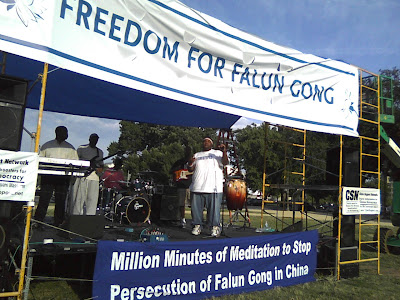 The China Support Network participated in a 'Freedom For Falun Gong' rally on Washington DC's National Mall on Sunday, July 19 2009, where I personally attended and gave a speech. (The speech can be seen in a separate blog post: http://chinasupport.blogspot.com/2009/07/full-text-of-july-19-speech-by-csns.html )
The guys and I need to have an "after action review," because I expect that we were surprised by what happened, and we are still sizing it up. Did we know what we were getting into?
There is no bad thing in Sunday's event. This is not a complaint -- far from it. "Wow!!!" is more closely the take away that I'm having.
It's this way: I can take credit for bringing in the rock band, Light Club, to the causes of Chinese democracy and of freedom for Falun Gong, Tibetans, Uighurs, and more groups that are persecuted in Communist China. It was 2005 when I invited Tim Britt and his bandmate Ron Luke to perform at the commemoration of the 16th anniversary of Tiananmen Square. They were being brought into the middle of the Chinese dissident scene in Washington, DC.
For that occasion, they were inspired to write and record the song, 'Remember Tiananmen Square,' in the style of American rock music. Previously, I was aware of one such song ('The Ghosts of Beijing' by Eye In The Village) that was recorded in 1989 just after Tiananmen Square's bloody massacre of June 4 that year. And of course, Axl Rose from Guns'n'Roses was reportedly working on an album called Chinese Democracy.
--But aside from that, the U.S. rock music scene had been silent for 16 years on this topic. The emergence of new rock music for the cause was going to be big, especially for the Falun Gong community which was just coming out of its shell.
The backstory on Falun Gong is this: In 1989, it didn't exist. In 1992, it was introduced. It had explosive growth of popularity in China, until its size was estimated in the range of 70-100 million members. That scared the chief of the Communist Party, and a crackdown commenced in 1999. In 2004, a related newspaper published 'Nine Commentaries on the Communist Party' and began the movement to have all Chinese quit and resign their membership in the Communist Party. In those days of 2004-2005, the Falun Gong community (perhaps they can be called "neo-dissidents") was beginning to integrate better with other groups such as the secular pro-democracy movement ("paleo-dissidents").
Being in on the planning stages with Britt and Luke, we realized that U.S. rock music was coming from an alien culture in the eyes of those from Mainland China. We realized that the dissidents had never heard anything like this -- strong American rock music as a delivery vehicle for a pro-Chinese democracy message. It was even said that the Falun Gong "didn't like" rock music. We were going to get in everybody's face -- from Beijing thru Chinese diaspora thru the American public -- with this music, carrying a hard-edged political message.
They loved it! --A Falun Gong practitioner suggested expanding on the 'Bye Bye CCP' theme, and that inspired a second song, 'Bye Bye CCP.' The Falun Gong TV studio made two music videos that were done as footage montages with those two songs. The U.S. rockers had touched a chord (or in the eyes of Beijing, where Falun Gong is banned and verboten and persecuted, a raw nerve).
More collaboration followed. The Human Rights Torch Relay (HRTR) in 2008 brought together all of China's persecuted to call for human rights ahead of the Olympics. Light Club wrote and recorded another song, 'Freedom First, Olympics Second' for our coalition by the same name. HRTR elevated more musical acts into the picture, and released a compilation CD called 'Songs to Save the World: Music of the Human Rights Torch Relay."
This may have meant that more musical acts were nipping at our heels, but we welcomed that because we want the good cause of Chinese rights to grow. And, Light Club's picture was on the CD cover and the lead song was 'Freedom First, Olympics Second.'
Just when you're feeling on top of the scene, you can't grow complacent. The foregoing is backstory to the "Wow!!!" that I am still having from what we witnessed yesterday.
And, I can't claim credit for bringing a new act onto the scene: Jared Pearman organized yesterday's event for Friends of Falun Gong. CSN co-sponsored. I think that at CSN, we were all surprised because Jared had invited us, but had not shown us the rest of the program lineup. In our experience, we would have expected a lot of speeches, plus Light Club and possibly one or two other musical acts.
So, we arrived at the National Mall and act after act after act appeared, sprouting like mushrooms. Jared had not told us that he was throwing a musical Woodstock for this final rally in the week that marks 10 years of Falun Gong persecution. "Wow!!!"
In fact, the Light Club band was also running the amplifiers, sound system, and sound board for the event. --I don't think they knew what was about to hit them.
Jared may be a practitioner of Falun Gong, but he is also a practitioner of opaque scheduling. While introducing Light Club, he stepped up to a mike and told the crowd as much.
"Being the person that I am, I rearranged the schedule right from the very beginning. And Light Club has been really gracious. These guys are running sound for our event; they drove all the way down from Connecticut to be here today with us. They're doing sound for the event; it's been a really really great pleasure to have them. I've been a thorn in their side rearranging things and changing everything up to the last minute, and I'm gonna do some more of that later on today, sorry about that guys..."
About ten minutes later I began my speech. I had prepared remarks designed to rip into Hu Jintao, the President of China, and also to scold Barack Obama, the President of the United States. And this was politically breaking some new ground in the free Chinese movement. Falun Gong and the China Support Network previously joined in a Global Coalition to Bring Jiang to Justice. That refers to the previous Chinese President, Jiang Zemin, who began the persecution of Falun Gong.
But, Falun Gong did not create a matching Coalition to Bring Hu to Justice. Even though the current Chinese President Hu continued the persecution, his is "the new administration," and the Falun Gong hope that he will reverse course. While that was understandable at first when Hu was new, it was unrealistic and the passage of time bears out the fact that Hu did not reverse the persecution. So, CSN has suggested the anti-Hu coalition, but Falun Gong did not agree with us.
Until today. Now, it must be clear to the Falun Gong that their's is not the most recent crackdown. In 2008, a Tibetan crackdown made news, and just this month in 2009, a Uighur crackdown made news. It is already time to denounce Hu Jintao for the handling of the situation with Uighurs.
My view is that it is in fact time to send Hu Jintao to the Hague (the International Criminal Court) to face charges of genocide and crimes against humanity. Think about it: Falun Gong, Tibetans, and Uighurs have all become victims under crackdowns in the Hu Jintao administration. All three of these groups should be calling for Hu Jintao's scalp, and they are natural allies to join in a new Coalition to Bring Hu to Justice.
My speech did not press Falun Gong for a decision about a coalition; instead, my speech pressed Hu Jintao himself, suggesting that he should resign, surrender, and turn himself over to the International Criminal Court for prosecution.
Politically, it breaks new ground, because my earlier speeches didn't focus on Hu Jintao personally, just the Communist Party regime in general. I judged that the time was right for this. The latest crackdown was only two weeks earlier, and it brought to light another example of genocide and crimes against humanity, committed by Hu's government just this month. The Uighur crackdown is echoing the Tibetan crackdown of last year -- but already, the death toll is higher in this crackdown than in last year's.
So. It was important to rip Hu Jintao, and I did so. One can also note that mine was the keynote speech -- the program was largely music, not speeches. Jared and his wife and some other victims of persecution provided anecdotes about the persecution; so yes, the program had speech, but no Congressmen or secular Chinese dissidents.
'Point being, mine was the strong voice, not eclipsed by anything else on the program.
Or perhaps, I've got that exactly wrong. If we cease to think of music and speeches in different compartments, then the program overall had many strong voices: singing!
I continue to think "Wow!!!," and yesterday serves as an example that just when you think you've seen it all....you ain't seen nothing yet.
The enormous discovery came near the end of the program, when the rapper (and ordained deacon) Joe L. Da Vessel took the stage. OMG... Look at the bio and music pages at http://www.joeldavessel.com/. Can a Falun Gong rally be turned into a hip hop revival? If I didn't see it with my own eyes, I would not have thought it plausible.
Joe L. Da Vessel is a giant hulk physically, an imposing presence. I first met him when I stepped off the stage at the end of my speech. He was kicking back in a nearby van or SUV, and he and his manager shook my hand, and gave me a shrink-wrapped copy of a CD titled, "Testimony: 1 Lyrics 4 Life." The CD cover also has this clue: "The 2008 Gospel Music Stellar Award Nominee, Rap/Hip Hop Gospel CD of the year."
Likely, he had just overheard my speech, ripping into Hu Jintao. He asked me, "How do you pronounce the name of the Chinese President?" I replied appropriately, something like "Who gin tahw."
Soon enough, he was taking the stage, doing highly engineered rap music, and ripping a new orifice for Hu Jintao and the Communist Party. In fact, he was bellowing, "Hu Jintao! You are not God!" over and over again.

At one time, Tim Britt and Ron Luke were feeling that something big was going down, because they (Falun Gong) had never heard anything like the music they would put on the table. But at July 19's event, they were not the big discovery. (In fact, Light Club decided against performing their new song, 'Chinese Democracy Defiled,' feeling that the moment was not right to try the new achievement of performing it live.)
Well, they (Falun Gong) had never heard or seen anything like Joe L. Da Vessel hammering Hu Jintao. I could sense that something big was going down. This was the big discovery.
Apparently, Joe previously rapped out a song, "In DC We Demand The Vote," for District of Columbia voting rights, and that video was played at the Democratic National Convention (I got that from his MySpace page, myspace.com/joeldavessel ).
So clearly, he doesn't mind getting involved politically, and on July 19 we appreciated his presence and his appearance in support of freedom for Falun Gong and indeed, for all of China.
And of course, I'm happy to watch people pile on against Hu Jintao. In this way, I wasn't the only American offering a challenge, or a political assault that seems frontal and direct to Hu Jintao, on that day.
It's a heartwarming discovery, and for some in attendance it must have been jaw dropping. As mentioned above, American rock music was once an alien culture to Falun Gong. Hip hop is like a subculture all of its own, and would seem even farther removed from the experience of Falun Gong.
But it's like that -- at the event site, a reporter for the Epoch Times asked me to reflect on what changes I had seen across the ten year's time that we were marking in the persecution. I replied as indicated, that Falun Gong began by being known only to those in its own circle. Various different "interest groups" have discovered Falun Gong and vice-versa in these ten years.
It's inevitable that if you go to shout at the Chinese embassy, you will notice other demonstrators there, and realize that Taiwanese, Tibetans, Uighurs, Falun Gong, and secular dissidents are all regular protestors outside of Chinese embassies and consulates.
These ten years allowed for many exchanges, joint actions, and coalitions among the groups. All of these groups overlap in their common humanity. American rockers joined in the overlap, and now American hip hoppers are also coming together to denounce the persecution.
All there agreed that the persecution itself is ridiculously absurd. Indeed, Joe L. Da Vessel helped to ridicule it, listing some practices of the Communist Party and saying, "What is that?" as a short way to dispose of the matters' legitimacy.
He also sang his song, "Yea Though I Walk," a rap song built around the 23rd Psalm in the Christian Bible: "Even though I walk through the valley of the shadow of death, I will fear no evil, for thou art with me." Fearing no evil was an apt subtext for our event, as we indeed pushed back against evil -- that of China's Communist Party and Hu Jintao.


Thursday, July 09, 2009
Support the Uighurs, protest the slaughter!
ALERT OF IMMEDIATE PROTESTS
===========================
LOS ANGELES
Host: Uyghur Community in US
Date: Thursday, July 9, 2009
Time: 2:00pm - 6:00pm
Location: Federal Building
Street: 11000 Wilshire Blvd
City/Town: Los Angeles, CA
Phone: 310-883-5189
http://www.facebook.com/event.php?eid=127777380405
CANBERRA AUSTRALIA
Date: July 10, 2009
Where: In front of Chinese Embassy in Canberra
Address: 15 Coronation Drv,Yarralumla ACT 2600
When: 3pm
NEW YORK CITY
Place: Across The Street from the UN Building
Corner of 43rd Street & 1st Avenue
Time: 12PM - 2PM
Date: Friday July 10, 2009
Hosted by: Federation of Turkish American Associations (FTAA/TADF - Turk Amerikan Dernekleri Federasyonu)
Information:
email: tadf@tadf.org
http://www.facebook.com/event.php?eid=107743666891
LONDON
Host: Uighur People of London
Date: Wednesday, July 15, 2009
Time: 3:00pm - 6:00pm
Location: Chinese embassy
Street: 49-51 Portland Pl, London, W1B 1JL
Email: purdi_pimpcess@hotmail.com
Information: http://www.facebook.com/event.php?eid=127436610785&ref=mf
Wednesday, June 24, 2009
WJSF releases Farsi tract
RT Chinese dissident Wei Jingsheng Foundation released Farsi translation of 'The 5th Modernization' http://tinyurl.com/d57cjz #iranelection
Friday, June 05, 2009
Good videos - June 2 - 3, 2009
The China Support Network recommends taking in these YouTube videos:
1. Nancy Pelosi speaks for over 10 minutes on the floor of the U.S. House of Representatives, about the June 2, 2009 resolution for the 20th anniversary of Tiananmen Square
2. Lhadon Tethong, Executive Director of Students for a Free Tibet, speaks at a June 3, 2009 gathering of Tibetans in solidarity with Tiananmen victims
June 4, 2009 (c) Hong Kong crowd astonishes media
June 4, 2009 (c)
Enormous crowd quadruples the usual size of turnout
for a Tiananmen anniversary vigil in Hong Kong
The following is a blog post by Shanghai correspondent Malcolm Moore of the Telegraph:
Even before I reached Victoria Park for tonight's candlelit vigil, I heard it. My hotel looks over the park, and I heard the first shouts at 5pm, three hours before the event started.
As it turns out, the vigil attracted far more people than Victoria Park's six football pitches could hold - 150,000. Amazingly, more people turned up than on the first anniversary of the Tiananmen Square bloodshed.
It was a heartwarming experience to see so many people, all singing and waving candles. When you live on the mainland, you forget about the strong emotions that unite such large crowds.
If you wanted to snipe, you could say that local pro-democracy parties (HK has said there will not be full parliamentary democracy on the island until 2017 at the earliest) may have whipped people up. Perhaps the people were coming to sound off about local politics as much as to protest against Beijing.
And if they really thought about it, democracy on the mainland may not be in Hong Kong's interests - the lives of the Cantonese on this island are very different from those of mainland Chinese and their views may not find much representation in one unified state.
But at heart, these 150,000 people came because they feel deeply Chinese and because they felt a deep obligation to do something that mainlanders cannot do - speak freely and with emotion.
June 4, 2009 (b) Tiananmen leaders presser coverage
June 4, 2009 (b)
Tiananmen Square student leaders again call
for Chinese democracy
Following is the text of a news article by AFP, the French newswire:
Tiananmen leaders call for China democracy
By Shaun Tandon
WASHINGTON (AFP) — Leaders of the 1989 Tiananmen Square uprising crushed 20 years ago appealed Thursday for democracy in China, with US lawmakers pledging support amid silence in Beijing on the anniversary.
Nine of the top student leaders, who now live in exile, reunited at a Washington news conference where they observed a moment of silence for the hundreds, perhaps, thousands killed when the army sent in troops.
"It is our unfailing pursuit to build a democratic China," some 15 dissidents said in a joint statement read out by former student leader Wang Dan, who had topped Beijing's most wanted list.
"We are calling on the generation of the 1989 massacre, both in China and overseas, as well as those who came before us and those who will come after us to work together and combine our strengths," they said.
Key figures from the Tiananmen movement also enjoyed a show of support at the US Congress, where House Speaker Nancy Pelosi welcomed three men who defaced the giant portrait of Mao Zedong in Tiananmen Square.
The three men, who now live in the United States and Canada, said they endured intense abuse in custody after their arrests.
"Imagine the courage against the regime that they continue to express at the expense of their lives and liberty," said Pelosi, who dressed in white as a sign of mourning in line with a call by dissidents.
Pelosi visited China last week, where she said she personally petitioned President Hu Jintao for the release of Tiananmen Square prisoners and detained human rights activists.
China has tried to block any commemoration of the anniversary, pouring police into Tiananmen Square and blacking out foreign media reports.
Congressman Jim McGovern, like Pelosi a member of President Barack Obama's Democratic Party, said the dissidents should be encouraged by Beijing's reaction.
"If the survivors of Tiananmen Square think they were somehow defeated, just look at the impact the very idea of remembering or talking about those events is having on the Chinese government," he said. "They are scared to death."
US Secretary of State Hillary Clinton on Wednesday called on China to provide a public account of the dead, missing and injured and to release prisoners still being held for taking part in the protests.
China flatly rejected her call, with a foreign ministry spokesman saying that "on the political incident that took place in the 1980s, the party and the government have already reached a conclusion."
Wang Dan, the former student leader, said the comment showed that China's government has not changed.
"Many Western leaders and President Ma Ying-jeou in Taiwan believe that the leadership in China is not the same one as 20 years ago. I think that what this spokesperson said shows they're wrong -- the Chinese Communist Party has not changed one bit," Wang said.
Ma, who has championed reconciliation with mainland China, had said that Beijing is now willing to discuss human rights, pointing to a Human Rights Action Plan released earlier this year by China's cabinet.
The Tiananmen dissidents voiced optimism about movements such as Charter 8, a petition drive in which leading intellectuals at great risk to themselves pushed last year for democratic reforms in China.
"We believe that China's hope lies with the efforts of the Chinese people themselves and with political reforms, which are currently turning in the direction of the people," the statement said.
June 4, 2009 (a) Nancy Pelosi statements
June 4, 2009 (a)
U.S. House Speaker Nancy Pelosi made four more gestures
(in addition to her hand in the June 2, 2009 passage of a House Resolution)
for the 20th anniversary of Tiananmen Square:
1.* She spoke about Tiananmen Square in her own press conference;
(* see relevant text, below)
2.* She attended a Tiananmen Square-specific press conference, at which she had
prepared remarks (* below);
3. She noted the "opening of a photo exhibit under the auspices of the National Endowment for Democracy";
4.* She attended a Tiananmen Square-specific rally on the West Lawn of the U.S. Capitol
(* speech below)
*1. Press conference excerpt:
As was reported to you a couple of days ago, last week I led a bipartisan delegation to China. At that time, we talked about climate change and how our two countries could work together to come to some agreement that would fit within a bilateral Copenhagen Agreement.
We also talked about human rights. And as you probably know, today is the 20th anniversary of the Tiananmen Square massacre. We have a number of events following this: an opening of a photo exhibit under the auspices of the National Endowment for Democracy; following that, an event on the West Lawn of the Capitol.
And, yesterday -- day before -- we had a resolution on the floor of the House that passed overwhelmingly in a strong bipartisan way.
*2. Prepared remarks of Nancy Pelosi for Tiananmen Square
-related press conference:
"Today, I am honored to join with Harry Wu and three former Chinese prisoners who were arrested during the Tiananmen Square protests.
"I had the opportunity to meet with them -- Yu Zhijian, Yu Dongyue, and Lu Decheng -- in the Speaker's office yesterday. Together, they spent nearly 40 years in prison. It is a relief that they are finally free.
"I would also like to thank Harry Wu for leading the effort to display the Tiananmen Photo Exhibition here in the Rayburn Building by Pulitzer Prize-winning journalists David and Peter Turnley.
"Twenty years ago this week, thousands of Chinese students, workers, and citizens assembled in Tiananmen Square.
"They called for the elimination of corruption. They called for an acceleration of democratic reform, freedom of speech and assembly. They called for a dialogue with China's leaders on how to make progress for the future.
"We remember with sadness and outrage how China's military was unleashed on its own people.
"One of the most enduring images of the 20th Century will forever be seared into our conscience -- the picture of the lone man standing in the street, bringing the line of tanks to a grinding halt.
"Yesterday, the House of Representatives sent a clear message by passing a resolution commemorating the 20th Anniversary of Tiananmen Square, calling on China to allow full and independent investigations into the massacre, and calling for the release of those imprisoned in the 1989 protests.
"Last week, I had the opportunity to lead a bipartisan delegation to China. The topic of human rights was discussed in our high level meetings and in my speeches.
"In particular, I delivered a letter calling for release of certain prisoners of conscience, in accordance with the principles in China's Constitution.
"Liu Xiaobo is one of those individuals. Liu spent five years in prison for supporting the Tiananmen students and questioning the one-party system.
"Late last year, Liu was again arrested for being one of the organizers of Charter '08, an online public petition for democracy and the rule of law.
"Liu continues to be held without charges. Today, we call for his immediate and unconditional release.
"Many in China do not know about the events of June 4th, but they continue to fight for the same causes -- accountability from the government, freedom from corruption, and respect for the rule of law.
"Today we say to the people of China and freedom-loving people everywhere: Your cause is our cause. We will never forget. We will never forget."
*4. The full text of her speech:
“Good afternoon. Thank you very much Yang Jianli and the Initiatives for China for bringing us together this morning and this afternoon.
“Words fail me to adequately tell you what an honor it is to be on the same stage and in the presence of so many of the heroes of June 4 — to have a message at the same time from His Holiness the Dalai Lama in solidarity for more openness in China and Tibet.
“We stand here in front of the Capitol of the United States, a beacon of freedom to the world, with a great history of free speech and open discussion.
“On this side of the Capitol, here on these grounds, we stand with people who took to heart and to mind, the words of our Founders. In our Declaration of Independence, in our Constitution, our words talked about every person being equal and ‘endowed by their creator.’ ‘Endowed by their creator,’ not by the state, but ‘endowed by their creator’ of certain rights like liberty and the pursuit of happiness. And it was for life and liberty — and some people paid that price in Tiananmen Square. They paid with their lives and their liberty to speak out for freedom.
“It’s interesting to me that this week there are also observances in Eastern Europe about freedom emerging there at this time 20 years ago. And for those of you who are old enough to remember Tiananmen Square, you would have seen that the students gathered in the square in May in the days leading up to June 4th were an inspiration to the world, to the entire world. They inspired others to have the courage and they had a drumbeat of liberty and freedom that was felt around the world.
“What they wanted was dialogue with their government on openness and freedom and freedom of speech and religion and ending the corruption in China. They wanted that dialogue, they wanted that conversation — what they got was crushed. Crushed. Some of those people crushed in the square and other streets of Beijing. But they could not crush the spirit of Tiananmen.
“And that’s why it’s important these 20 years later — I remember meeting Chai Ling in Paris. She was newly escaped from China — we are so proud of her, she is so courageous, and so many others, so many other heroes of that movement. Many of them, when they got out of China, signed my man before the tank poster in my office, which is getting old now, but I’m very proud of the signatures that are on there. They are the signatures to a declaration of freedom in China and what this freedom means is openness, freedom of speech, freedom of religion, accountability, rule of law according to the Chinese Constitution.
“So what is important for us to do now? Who would have ever thought all of you here who are gathered with great leaders for democracy? Who would have ever thought that 20 years later, we would still be in this situation? That the same cowardice that inspired — I don’t know if inspired is the word — that insisted that the regime crush the people in the square — to clear that square at such and such a time. The same cowardice that did that — that same fear of the people exists in China today.
“We were told 20 years ago that peaceful evolution and economic reform would lead to political reform. Indeed, the economic reform has occurred. And I was so pleased that Secretary Clinton said in a statement that China has made enormous progress economically. I saw that last week in China. But she also said that a China that had made all that progress should examine openly the darker events of its past and provide a public accounting of those killed at Tiananmen Square — both to learn and to heal. We need to do that as we go forward.
“I also want to reference a speech made by President Obama in Egypt today. President Obama made a very excellent speech in Egypt and this is what he said there: ‘But I do have an unyielding belief that all people yearn for certain things. The ability to speak your mind and have a say in how you are governed, confidence in the rule of law and equal administration of justice, a government that is transparent and doesn’t steal from the people, the freedom to live as you choose. Those are not just American ideas, they are human rights, and that is why we will support them everywhere.' That is what the President said in Egypt, looking out to the Muslim world.
“I have said over and over again: if we do not support human rights in China and in Tibet, we lose all moral authority to speak about human rights any place in the world. So here we are in front of the Capitol, a building symbolic of the core values of our American independence and our Constitution, in solidarity with those who, using our words, modeling the Goddess of Democracy after the Statue of Liberty, having those aspirations — people carrying those aspirations crushed in Tiananmen Square.
“Twenty years later, the spirit is still alive. In Hong Kong in the observance of Tiananmen Square, over 150,000 people turned out last night. 150,000 people — the biggest crowd since the one-year anniversary of Tiananmen Square. So I know that the long arm of the Chinese government will be reaching out to the media all over the world to suppress reporting on what’s happened in China, and also restricting communication from China through the Internet and the rest, but the fact is that here we are at the Capitol, there they were in Hong Kong, a drumbeat of activity across the world, an echo of the voices of the heroes of Tiananmen. We will never forget. We want a record of what happened, and we will continue to work for more openness and improvements in human rights in China and Tibet.
“Thank you for your courage to turn out here today, to stand in front of the Capitol, to hold us accountable to our own values, and to continue to work together to remember the Tiananmen Square Massacre, to get a public accounting of it
“And let me say just one thing in closing that was shocking to me. On the way there — perhaps you’ve seen the Frontline documentary on Tiananmen Square? And they have a picture of the man before the tank, this picture, an icon that is seared in the minds of people throughout the world. And they had in this documentary that they showed it to some students at Beijing University just a couple of years ago and those students had no idea what the photo was. They said, ‘What is that? Is that art? Did you put that together?’ This is an indication of how the Chinese government has suppressed what happened on June 4th and the days leading up to it.
“So our work is large. It’s work that many of us have been involved in for 20 years. In 1991, I stood in the square and unfurled a banner remembering those who sacrificed so much in Tiananmen Square. I wear white today to signal to the families a sympathy for what they have lost. I did that in 1991 as a Member of Congress, an individual Member, to express my views and the views of my constituents. It was a bipartisan group of us on the square that day, Democrats and Republicans.
“Eighteen years later as Speaker of the House, I had the opportunity to sit across from the President of China, the Premier of China, the Chairman of the People’s Congress, and to express to them the bipartisan concern in the Congress of the United States about China’s human rights record both in China and in Tibet.
“Whatever our roles in whatever stage of our involvement, we have to use everything at our disposal so that they know that we have not forgotten, and that we will not rest until there is freedom of speech and expression and assembly and openness in China and in Tibet.
“So thank you all very much for coming out today. Thank you for what you have done, thank you for what you are going to do, thank you for giving me the privilege of being associated with this very important historic movement for freedom in the world.
“Thank you all very much.”
June 3, 2009 (b) John Kusumi statement
June 3, 2009 (b)
John Kusumi, founder of the China Support Network,
calls for Chinese people to rise up and sweep
away "the model of government-by-gangster"
Full text of the speech:
"'Game on' for Revolution!"
A speech by John Kusumi, Director emeritus of the
China Support Network, a pro-democracy group
- for the 20th anniversary of Tiananmen Square -
- as prepared for vigil of June 3, 2009 -
- Victims of Communism Memorial, Washington, DC -
I want to thank the many friends of freedom who are gathered here. 20 years after a bloody massacre in Beijing, China, the Chinese democracy movement still exists -- in exile, and gathered right here, right now to say "Never Forget," and "Never Again." My group, the China Support Network, still exists -- largely off the radar of sellout news media.
Tiananmen Square had more than a massacre. First, before the army came in, it had an uprising. It was not quite a counter-revolutionary rebellion, but it was a determined, insistent, and unyielding demand for political reform. Inside the high echelons of the Communist Party, there was a power struggle. And, if a different faction had won that power struggle, there would have been peace instead of violence; good instead of evil; and change instead of schlerosis. The title of Shen Tong's book says it well: "Almost A Revolution."
It would be well of United States journalists to focus on that aspect -- the forthcoming change of China -- rather than just photos of the military action.
The Communist Party greatly fears the Chinese democracy movement, because it had and still has the potential to change China's government. In the news this week, we have learned that the Chinese government blocked Twitter and Hotmail. Hello--?? They blocked Twitter and Hotmail!! --And that's in order to stop messages like mine, here.
I'll contribute my personal note here because 25 years ago this month, I started my mercurial -- independent -- teenager's campaign for U.S. President. I ran for the U.S. White House -- of course, I was minimized like Ralph Nader and I lost that race. But it becomes relevant when I am standing together with this reunion of Tiananmen Square leadership. In China, you were the first Generation X politicos. In America, I was the first Generation X presidential candidate. One has to remove the two-party blinders to see that, but it's not a stretch as I claim that mantle -- it is my record.
We are the youth of the 1980s, a decade when there was your attempt to change China, and my attempt to change America. Consider the combination! "We are Generation X, and we demand the keys to the kingdom!" --And next time, we won't take "no" for an answer.... ;)
In any case, I do fully support the Chinese democracy movement and its present-day agenda for political reform that is far-reaching and not just baby steps of incrementalism. There will be a change as the Communist Party is swept away, into the dustbin of history. There are consequences for blocking Twitter and Hotmail: we've got come down hard on them! Tell the people of China, it's "game on" for revolution!
The people of China must rise up, revolt, and sweep away the model of 'government-by-gangster.' The new law of Generation X -- those of us here -- says this: "If you block the emails, you will get a revolution." It's an important precedent to set. We can stop other governments from trying this malarkey in the future. If we can make this stick, government leaders will never again mess with Twitter and Hotmail -- and perhaps, not even with Generation X. :)
There is strength in this cause and in this movement. In 1989, students were asking the government for change. Some even kneeled on the steps of the Great Hall of the People -- and one of them, Zhou Yongjun, has been arrested again in China. He belongs here, at this event, today. We demand his release, and that of Wang Bingzhang, Liu Xiaobo, and Gao Zhisheng. This is 2009. This time, we are not asking the government, we are telling the government -- and calling for a revolution to come along side us.
We are standing where there is a statue of Tiananmen Square's Goddess of Democracy. I remember standing here in 2007 with Tang Baiqiao as he called for a second June 4 movement. With today's open call for revolution, his call is joined. Could the Chinese government negotiate, perhaps with Xu Wenli? Xu Wenli is a Chinese dissident who has called for a Future of China Conference, to be held this fall in Beijing. That, in preparation for a Constitutional Convention of 2010. Those events can and should happen, with or without the Communist Party at the table!
Xu Wenli released that schedule in 2006. Tang Baiqiao called for uprising in 2007. And today, I add my voice in calling for the same. Long live democracy, and may the future of China be bright! Thank you for taking in my speech, and God Bless China!
June 3, 2009 (a) Hillary Clinton statement
June 3, 2009 (a)
U.S. Secretary of State releases four paragraph statement
for the 20th anniversary of Tiananmen Square
Full text of the statement:
On this the 20th anniversary of the violent suppression of demonstrations in Tiananmen Square by Chinese authorities, we should remember the tragic loss of hundreds of innocent lives and reflect upon the meaning of the events that preceded that day.
Hundreds of thousands of protesters took to the streets for weeks, in Beijing and around the country, first to honor the late reformist leader Hu Yaobang and then to demand basic rights denied to them.
A China that has made enormous progress economically, and that is emerging to take its rightful place in global leadership, should examine openly the darker events of its past and provide a public accounting of those killed, detained or missing, both to learn and to heal.
This anniversary provides an opportunity for Chinese authorities to release from prison all those still serving sentences in connection with the events surrounding June 4, 1989. We urge China to cease the harassment of participants in the demonstrations and begin dialogue with the family members of victims, including the Tiananmen Mothers. China can honor the memory of that day by moving to give the rule of law, protection of internationally-recognized human rights, and democratic development the same priority as it has given to economic reform.
Thursday, June 04, 2009
June 2, 2009 Resolution in U.S. House
June 2, 2009
U.S. House of Representatives passes H. Res. 489,
for the 20th anniversary of Tiananmen Square
Full text of the resolution:
Recognizing the twentieth anniversary of the suppression of protesters and citizens in and around Tiananmen Square in Beijing, People’s Republic of China, on June 3 and 4, 1989 and expressing sympathy to the families of those killed, tortured, and imprisoned in connection with the democracy protests in Tiananmen Square and other parts of China on June 3 and 4, 1989 and thereafter;
Whereas freedom of expression and assembly are fundamental human rights that belong to all people, and are recognized as such under the Universal Declaration of Human Rights and the International Covenant on Civil and Political Rights;
Whereas June 4th, 2009, marks the 20th anniversary of the day in 1989 when the People's Liberation Army and other security forces finished carrying out the orders of Chinese leaders to use lethal force to disperse demonstrators in and around Beijing’s Tiananmen Square;
Whereas the death on April 15, 1989 of Hu Yaobang, former General Secretary of the Communist Party of China, was followed by peaceful protests throughout China calling for the elimination of corruption and acceleration of economic and political reforms, especially freedom of expression, and freedom of assembly; and calling for a dialogue between protesters and Chinese authorities on these issues;
Whereas by early May 1989, citizens advocating publicly for democratic reform across China included not only students, but also government employees, journalists, workers, police, members of the armed forces and other citizens;
Whereas on May 20, 1989, martial law was declared in Beijing after authorities had failed to persuade demonstrators to leave Tiananmen Square;
Whereas during the late afternoon and early evening hours of June 3, 1989, ten- to fifteen thousand helmeted, armed troops carrying automatic weapons and travelling in large truck convoys moved into Beijing to “clear the Square” and surrounding streets of demonstrators;
Whereas on the night of June 3 and continuing into the morning of June 4, 1989, soldiers in armored columns of tanks outside of Tiananmen Square fired directly at citizens and indiscriminately into crowds, inflicting high civilian casualties, and killing or injuring hundreds of unarmed civilians, who reportedly ranged in age from 9 years old to 61 years old; and whereas tanks crushed some protesters and onlookers to death.
Whereas even after 20 years, the exact number of dead and wounded remains unclear; credible sources believe that a number much larger than that officially reported actually died in Beijing during the period of military control; credible sources estimate that the numbers of wounded at least were in the hundreds; detentions at the time were in the thousands, and some political prisoners who were sentenced in connection with the events surrounding June 4, 1989 still languish in Chinese prisons;
Whereas there are Chinese citizens still imprisoned for “counter-revolutionary” offenses allegedly committed during the 1989 demonstrations, even though, according to the 1997 revision of China's Criminal Law, the “offenses” for which they were convicted are no longer crimes.
Whereas the Tiananmen Mothers is a group of relatives and friends of those killed in June 1989 whose demands include the right to mourn victims publicly, to call for a full and public accounting of the wounded and dead, and the release of those who remain imprisoned for participating in the 1989 protests;
Whereas members of the Tiananmen Mothers group have faced arrest, harassment and discrimination; the group’s Web site is blocked in China; and international cash donations made to the group to support families of victims have been frozen by Chinese authorities;
Whereas Chinese authorities censor information that does not conform to the official version of events surrounding the Tiananmen crackdown, and limits or prohibits information about the Tiananmen crackdown from appearing at all in textbooks in China;
Whereas Chinese authorities continue to suppress peaceful dissent by harassing, detaining or imprisoning journalists, advocates for worker rights, religious believers, and other individuals in China, including in Xinjiang and in Tibet who seek to express their political dissent, ethnic identity or religious views peacefully and freely;
Whereas Chinese authorities continue to harass and detain advocates for democratic processes such as Mr. Liu Xiaobo, a Tiananmen Square protester, prominent intellectual, dissident writer, and more recently a signer of Charter 08 (a call for peaceful political reform and respect for the rule of law published on-line last December by over 300 citizens and subsequently endorsed by thousands more), who remains under house arrest.
Now, therefore, be it Resolved, That the House of Representatives—
(A) expresses sympathy to the families of those killed, tortured, and imprisoned as a result of their participation in the democracy protests in Tiananmen Square and elsewhere in China on June 3-4, 1989 and thereafter, and all those persons who have suffered for their efforts to keep that struggle alive during the last two decades;
(B) calls on the People’s Republic of China to invite full and independent investigations into the Tiananmen Square crackdown, assisted by the United Nations High Commissioner for Human Rights and the International Committee of the Red Cross;
(C) calls on the legal authorities of the People’s Republic of China to review immediately the cases of those still imprisoned for participating in the 1989 protests for compliance with internationally recognized standards of fairness and due process in judicial proceedings and to release those individuals imprisoned solely for peacefully exercising their internationally-recognized rights;
(D) calls on the People’s Republic of China to end its harassment and detention of and its discrimination against those who were involved in the 1989 protests not only in Beijing, but in other parts of China where protests took place; and to end its harassment and detention of those who continue to advocate peacefully for political reform, like Mr. Liu Xiaobo, a signer of Charter 08 who remains under house arrest, and his wife, Liu Xia.
(E) calls on the People’s Republic of China to allow protest participants who escaped to or are living in exile in the United States and other countries, or who reside outside of China because they have been “blacklisted” in China as a result of their peaceful protest activity, to return to China without risk of retribution or repercussion.
(F) calls on the Administration and Members of the Congress to mark the 20th Anniversary of the events at Tiananmen Square appropriately and effectively by taking steps that include: meeting whenever and wherever possible with participants in the demonstrations who are living in the United States, and meeting with others outside of China who have been "blacklisted" in China as a result of their peaceful protest activities; signaling support for those in China who demand an accounting of the events surrounding June 4th, 1989; and expressing support for those advocating for accountable and democratic governance in China.
Wednesday, May 13, 2009
- Good news, bad news, and a clarification -
Today's good news is that major news wires have "broken" the story that Chinese dissident Zhou Yongjun (also known as Majer Zhou, his English name), a former Tiananmen Square student leader, was arrested and is being held (unjustly) in China, by "the authorities," or the Chinese Communist Party.
To bring this to world attention is a positive, constructive step and therefore it is today's good news. The bad news is that, "They're holding Majer Zhou!" This is a new Tiananmen-Square related arrest -- the continuation of a crackdown that has happened for almost 20 years. (June 4, 2009 will be the 20th anniversary of the Tiananmen crackdown.)
The clarification is this: Most of the coverage correctly identified Zhou as a U.S. permanent resident, or a "green card holder." That's correct. He would have obtained that green card in 1993, when he first came to the United States for exile.
The clarification becomes necessary where the Associated Press, within its article, reported: "Zhou had applied for but does not yet have a green card, his family said."
This was an exchange with perhaps a misunderstood question, or a misunderstood answer. The source of that statement, Ms. Yuewei Zhang, clarified to CSN that Zhou applied for naturalization (a step to citizenship) two years ago, but that it's not approved as yet.
Naturalization is a completely different matter than U.S. permanent residency. The former is an application process now interrupted. The latter is something that Zhou Yongjun already has.
We can therefore underscore that yes, Majer Zhou is a U.S. permanent resident. And as the CSN has reported in connection with other political prisoner cases, "Yes, Virginia, there is such a thing as a non-citizen U.S. national." A permanent resident may be considered a U.S. national.
It is also true that the China Support Network (CSN) was mentioned in the related coverage by the New York Times and the AFP news wire.
Tuesday, May 05, 2009
Earlier draft of Zhou Yongjun story
Tiananmen Square Student Leader Captured
CSN demands the immediate release of Zhou Yongjun
April 16, 2009 (CSN) -- One of the student leaders at Tiananmen Square was named Majer Zhou -- or if you are Chinese, his name is Zhou Yongjun. He has now been captured. He is the latest case of a prisoner in China whom we need to demand that the Chinese authorities must release.
He has been living in the United States and has been an enthusiastic ally of the China Support Network. He spent some time being the North American Director of the Free China Movement. And his placement in the Chinese democracy movement is as solid as they get.
When the students rose up in Tiananmen Square, he led the first student march into the square, that got the action started in the first place. And then, he was the first elected leader of the student association -- they made a combined association of Beijing Universities -- in Tianamen Square.
He was elected there; he was a spokesman of the students; and he appears in a famous photograph of students kneeling on the steps of the Great Hall of the People. Zhou was one of the three students kneeling with a petition that looked to be a scroll intended for the emperor. That scene took place during the funeral for ousted Chinese leader Hu Yaobang.
Books about Tiananmen Square's June 4 movement mention Mr. Zhou. Zhou is a blue-chip name among the Tiananmen Square student leadership, and he has been captured in China.
This is now his third time to be a political prisoner in China. He was jailed immediately after Tiananmen Square's 1989 atrocity, then released in 1991. He made his way to the United States for exile. In 1998, he attempted a return to China. Then, he was picked up by the authorities and sentenced to three years in a labor camp. He was released nine months early in 2001 as a government gesture to win favor with the International Olympic Committee.
Heretofore, this was the "rumored disappearance" of Majer Zhou. The China Support Network is confirming the story ahead of the newswires and the Chinese government. Prominent dissident attorney Ning Ye, and another source inform CSN that Mr. Zhou is being held at a prison in Shenzhen.
In English, the only earlier report was on Dec. 19, 2008 when the China Aid Association reported that Zhou was arrested on Sept. 30, and that authorities first charged him with "espionage," then changed the charge to "financial fraud."
The China Support Network calls upon the government of China to immediately release 'Majer' Zhou Yongjun. If he is not present at the upcoming 20th anniversary of the June 4 massacre, he will be conspicuous by his absence, and circumstances will require that we must clatter and raise pressure for his release amid the commemorations for June 4 -- the yearly time of world attention for the June 4 issue.
Monday, April 13, 2009
Invitation to New York event
NYU Wagner’s International Public Service Association (IPSA-Wagner) presents:
HUMAN RIGHTS VIOLATIONS AGAINST THE UYGHUR PEOPLE OF THE XINJIANG UYGHUR AUTONOMOUS REGION OF CHINA (EAST TURKISTAN)
Learn about the Chinese government’s human rights violations against the Uyghur people, the forcible return to China of Uyghur asylum-seekers and refugees by China’s neighbors, and the detention of Uyghurs at Guantanamo. Find out what you can do to help the Uyghurs.
Date and Time: Thursday, April 16, 2009, 6:30 p.m. – 8:00 p.m.
Location:
Rudin Family Forum
New York University Robert F. Wagner Graduate School of Public Service
295 Lafayette Street (Puck Building)
New York, NY 10012
*The Rudin Family Forum is on the 2nd Floor of the Puck Building.
**Non-NYU attendees must show ID at the security desk on the 2nd floor (take the elevator to the 2nd floor). Non-NYU attendees, please also try to RSVP. You can do that by filling out the short RSVP form at http://wagner.nyu.edu/events/ipsa-04-16-2009.
Featuring:
NURY TURKEL, ESQ. -- Mr. Turkel, a Uyghur, is former President of the Uyghur American Association and former Executive Director of the Uyghur Human Rights Project.
Screening of a short documentary on the Uyghurs.
Action opportunities.
Background:
The Uyghurs are the Turkic Muslim people of the Xinjiang Uyghur Autonomous Region in northwestern China (known to the Uyghurs as East Turkistan).
For decades, the Chinese government has subjected the Uyghurs to political, religious, and cultural persecution. Several of China’s neighbors have assisted the Chinese government’s persecution of the Uyghurs by forcibly returning Uyghur asylum-seekers and refugees to China, where they face severe human rights abuses, including imprisonment, torture, and in some cases, execution.
Since September of 2001, the Chinese government’s crackdown on the Uyghurs has steadily intensified. The government has consistently portrayed the Uyghurs’ political, religious, and cultural activities as terrorism to justify its crackdown on the Uyghurs.
Although there are currently 17 Uyghur prisoners in Guantanamo Bay, Cuba, most of them have been cleared for release, some as early as 2003. The U.S. government – aware that it cannot return the prisoners to China due to credible fears that they would be tortured upon return – has unsuccessfully tried to find another country to resettle the Uyghurs rather than resettle them itself. The U.S. has refused to resettle the Uyghurs in the U.S., despite their civilian status and assurances by the Uyghur-American community and interfaith refugee settlement groups that they would provide the Uyghurs with housing and language and job training. No other country has offered to accept the Uyghur prisoners, in part – according to Human Rights Watch – because of the U.S.’s failure to resettle any detainees itself.
Note: The Puck Building, 295 Lafayette Street, NY, NY is walking distance from the Broadway-Lafayette subway station (B,D,F,V trains), Bleecker Street subway station (6 train), and the Prince Street subway station (R train).
Tuesday, March 10, 2009
Wei Jingsheng appears with Tibetans
The following news was run by AFP, the newswire:
In Lafayette Park facing the White House, hundreds of exiles holding Tibetan and US flags bowed their heads in prayer.
The protesters marched to the Chinese embassy joined by one of China's most famous dissidents, Wei Jingsheng, who has questioned historical claims to Tibet put forward by his country's leaders.
"The Tibetans have been deprived of their right to protest but we can see that they are very strong," Wei told AFP.
Thursday, February 26, 2009
Prepared Remarks of Rep. Chris Smith (R-NJ)
From a press conference of Feb. 26, 2009:
Good morning and thank you for coming here today. I’m here with Congressmen Mike Pence, Frank Wolf, and Joe Pitts and a group of former political prisoners and human rights activists to talk about U.S. policy toward China.
Last week, Secretary Clinton told the global media that concern for the protection of human rights of the Chinese people can’t be allowed to “interfere” with the economic crisis, climate change, and security – as if human rights were disconnected and irrelevant to those issues.
With those words, the Secretary effectively took human rights off the U.S. agenda with the Chinese Government. It was a shocking display of pandering, immediately understood by the Chinese government, whose party-controlled press rejoiced. Secretary Clinton made it clear in Beijing that the Obama Administration has chosen to peddle U.S. debt to the largest dictatorship in the world over defending the Chinese people from its government’s policies of torture, forced labor, forced abortion, religious persecution, human sex trafficking, gendercide, and genocide.
Forced abortion deserves a special word in this list of human rights abuses, as it is the only one that the Democratic Congressional leadership appears determined to fund with U.S. taxpayer money. Yesterday the Democratic leadership blocked amendments to the FY 2009 Omnibus spending bill that would prevent President Obama from lavishing $50 million of U.S. taxpayer money on the UN Population Fund (UNFPA). U.S. Government reports and the international media have consistently found that the UNFPA systematically aids and abets the Chinese government’s one child per couple forced abortion policy. That cruel, anti-family policy has made brothers and sisters illegal in China and murdered tens of millions of children and wounded countless Chinese women.
The protection and promotion of human rights ought to be at the core of our relationship with an egregious violator like China – but the Secretary has signaled that for her it will be a talking point at the bottom of the diplomatic agenda--one she’s in no hurry to get to.
In a sad irony, within days of the Secretary’s airy dismissal of human rights, the Department of State issued its Congressionally-mandated annual Country Reports on Human Rights, which concluded that in 2008 the Chinese government’s human rights record “worsened.”
Every day, brave Chinese risk their lives and liberty in the pursuit of freedom, democracy, protection of the family and respect per human rights. As we speak, Chinese political prisoners languish in gulags – laogai concentration camps – facing unspeakable torture and abuse. As a matter of a fact, approximately half a million each day endure the cruelty and humiliation of the labor camp.
When I read the Secretary’s words, I thought of Wei Jingsheng, the Democracy Wall hero who is here with us today. In 1999 Wei told me—When your government submits to the Chinese government’s demand to stop raising human rights issues, they beat us more; when you stand up to them, they beat us less.
Right now, Chinese political prisoners are paying the price for the Secretary’s words. They are being beaten. Their jailers are taunting them that the world has forgotten them, telling them that nobody cares about their fate.
Congressmen Pence, Wolf, and Pitts have joined me to deliver a message to the Chinese people: there are many of us in Congress who will not let the United States government forget about their human rights; we will keep speaking out for them; and we will do everything in our power to urge the administration to do the same.
After my colleagues speak, I will introduce the former political prisoners and human rights defenders.
Sunday, February 22, 2009
As Hillary Clinton shows weakness, Beijing wins a game with the U.S.
The following is an exceedingly good post from commentator Gordon Chang:
The Chinese Head Game
Gordon G. Chang - 02.22.2009 - 1:22 PM
“It’s a bit chilly in Beijing,” said Yang Jiechi, “but I have confidence that you will see the biggest number of smiling faces here.” China’s foreign minister was not commenting on yesterday’s weather in friendly banter with Secretary of State Hillary Clinton. His point was that China’s happy people were proof of the regime’s good human rights record.
Yang was lying, of course. But that’s not the point. Clinton knew he was lying, and that’s not the point either. The point is that Yang knew that Clinton knew he was lying but did not challenge him. The Chinese, in short, were putting forth their version of reality and Americans were accepting it. Minister Yang knew he had just humbled the United States.
“You know, a lot of international diplomacy is a head game,” Mrs. Clinton said on Friday before arriving in Beijing. She’s right, and the Chinese have just outmaneuvered her. She thought she could buy their good will by accepting an obvious deception. They, however, interpreted her acceptance of their outrageous views as a sign of weakness. As one Indian observer recently remarked, Beijing now perceives the United States to be “a beakless eagle.” Abe Greenwald noted on Friday that the issue of human rights in China cannot be separated from the supposedly “broader issues.” He’s correct because the Communist Party, which has yet to shed the mentality of its early years, only respects strength.
Mrs. Clinton has lost the initial round of the “head game,” so don’t expect Beijing to be cooperative in the near future. President Obama’s diplomacy in China has just gotten off to a truly bad start.
Saturday, February 21, 2009
More about today's editorial
There may be some people who did not read or hear the news, prior to the latest article 'Hillary Clinton Visits Her Communist Masters In Beijing.' Therefore, it may seem abrupt to take in an article which, under better (more normal) circumstances, could be termed shockingly rude.
These are not normal circumstances. For 20 years since the Tiananmen Square massacre, U.S. China policy has been morally indefensible, for turning a blind eye to the atrocities, the genocide, and the crimes against humanity which China's CCP government perpetrates against normal, innocent civilians in China. The CCP, by the way, is still the Chinese Communist Party, the same totalitarian institution that was brought to power by Chairman Mao in 1949.
Before arriving in Beijing, Hillary Clinton telegraphed her attitude about human rights. As reported in the Washington Post, "We pretty much know what they are going to say" on human rights issues such as greater freedoms for Tibet, Clinton told reporters traveling with her on a tour of Asia.
To help to put this into perspective, I will paste in an article from AFP (Agence France-Presse, the newswire) below. It has led to a situation where the human rights community should rightly be roaring angry with Clinton, and today's CSN article amounts to a verbal and rhetorical "hurling of shoes" at Hillary Clinton.
That is as it should be, in light of circumstances. It is a brilliant man in Iraq who started this trend of throwing shoes at world leaders. Recently, China's Wen Jiabao had shoes thrown at him in London. Isn't it great when people catch on? ;-)
Activists 'shocked' at Clinton stance on China rights
WASHINGTON (AFP) — Amnesty International and a pro-Tibet group voiced shock Friday after US Secretary of State Hillary Clinton vowed not to let human rights concerns hinder cooperation with China.
Paying her first visit to Asia as the top US diplomat, Clinton said the United States would continue to press China on long-standing US concerns over human rights such as its rule over Tibet.
"But our pressing on those issues can't interfere on the global economic crisis, the global climate change crisis and the security crisis," Clinton told reporters in Seoul just before leaving for Beijing.
T. Kumar of Amnesty International USA said the global rights lobby was "shocked and extremely disappointed" by Clinton's remarks.
"The United States is one of the only countries that can meaningfully stand up to China on human rights issues," he said.
"But by commenting that human rights will not interfere with other priorities, Secretary Clinton damages future US initiatives to protect those rights in China," he said.
Students for a Free Tibet said Clinton's remarks sent the wrong signal to China at a sensitive time.
"The US government cannot afford to let Beijing set the agenda," said Tenzin Dorjee, deputy director of the New York-based advocacy group.
China has been pouring troops into the Himalayan territory ahead of next month's 50th anniversary of the uprising that sent Tibet's spiritual leader the Dalai Lama into exile in India.
"Leaders really need to step up and pressure China. It's often easy to wonder whether pressure makes a difference. It may not make a difference in one day or one month, but it would be visible after some years," Dorjee said.
Amnesty International and Human Rights Watch had sent a letter to Clinton before her maiden Asia visit urging her to raise human rights concerns with Chinese leaders.
Before she left, State Department spokesman Robert Wood said human rights would be "an important issue" for Clinton and that she would "raise the issue when appropriate."
China has greeted President Barack Obama's administration nervously, believing he would press Beijing harder on human rights and trade issues than former president George W. Bush.
= = = = =
Other headlines:
CNN -- Clinton: Chinese 'human rights can't interfere' with other crises
Australian news -- In China, Clinton avoids rights issue
Radio Netherlands -- Rights groups shocked at Clinton's China stance
NDTV India -- Rights group slams Clinton's China remarks
USA Today -- Amnesty Int'l 'shocked' over Clinton's human rights remarks
Subscribe to:
Posts (Atom)